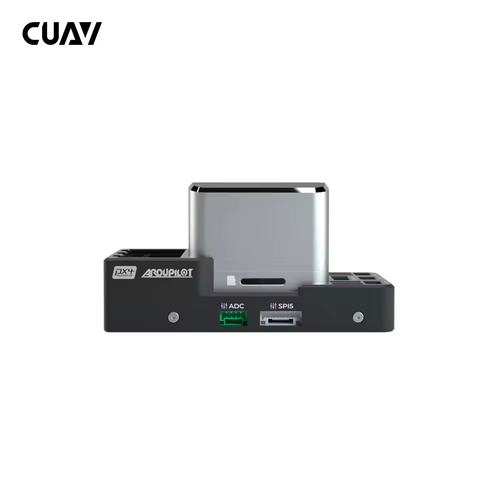
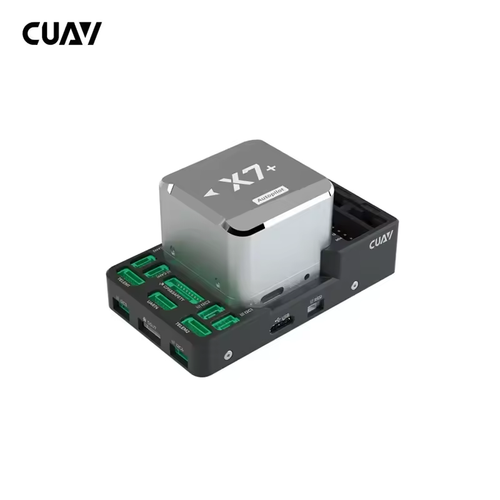
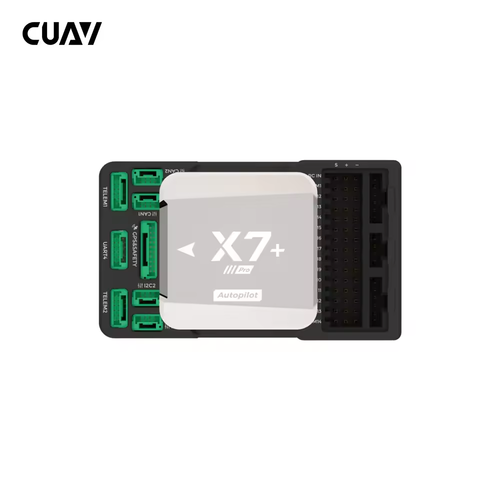
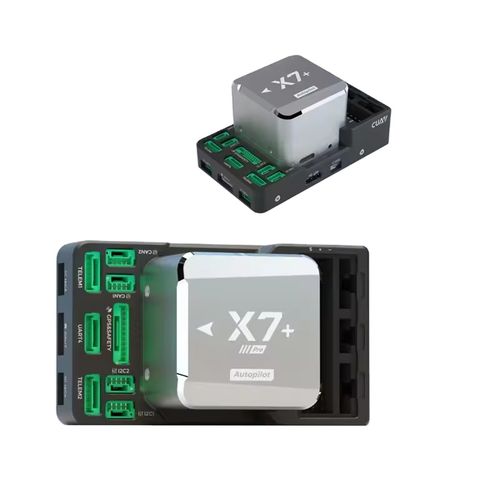
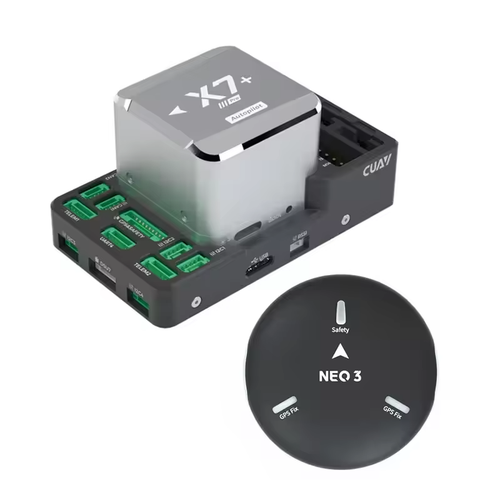
480MHz H7 Processor
The STM32H743 processor provides high-performance flight-control processing with a double-precision floating-point unit.


| Flight Controller | CUAV X7+ Pro |
|---|---|
| Processor | STM32H743, Arm Cortex-M7 |
| Processor Frequency | 480MHz |
| Floating-Point Unit | Double-Precision FPU |
| Flash Memory | 2MB |
| RAM | 1MB |
| Accelerometers and Gyroscopes | ADIS16470 + ICM-42688-P + ICM-20689 |
| Electronic Compass | RM3100 |
| Barometer | Dual MS5611 |
| Firmware Support | ArduPilot 4.1.0 / PX4 v1.13 or Later |
| OSD | Not Integrated |
| UART | 5 |
|---|---|
| I2C | 6, including two interfaces integrated with GPS, Safety and UART4 connections |
| CAN | 2 DroneCAN-compatible interfaces |
| ADC Input | 1, supporting 66V / 33V measurement configurations |
| SPI | 1 |
| PWM Outputs | 14 outputs; M1–M12 support DShot |
| RC Input | PPM / SBUS / DSM |
| RSSI Input | PWM or 3.3V analog voltage |
| Power Inputs | 2; Power A for ADC protocol and Power C for CAN protocol |
| GPS Ports | 2 |
| USB | 2 × USB Type-C |
| Storage Slot | 1 × TF Card Slot |
| Debug Interface | UART7 |
| JTAG | 1 |
| Rated Input Voltage | 4.5–5.5V |
|---|---|
| USB Input Voltage | 4.75–5.25V |
| Servo Rail Voltage | 0–36V |
| Operating Temperature | −20°C to 85°C |
| Dimensions | 77 × 45.5 × 39mm |
| Weight | Approximately 105g |
| Safety Switch | Integrated into the GPS and Safety port |
| Beeper | Integrated into the GPS and Safety port |
| GNSS Module | CUAV NEO 3 Pro |
|---|---|
| GNSS Receiver | u-blox NEO-M9N |
| GNSS Processor | STM32F412 |
| Electronic Compass | RM3100 |
| Satellite Systems | GPS / GLONASS / Galileo / BeiDou |
| Concurrent GNSS | Four satellite systems simultaneously |
| Navigation Update Rate | Up to 25Hz |
| Horizontal Accuracy | 2.0m nominal; up to 0.7m measured under suitable conditions |
| Speed Accuracy | 0.05m/s |
| Maximum Satellites | 32+ |
| Communication Protocol | DroneCAN |
| Filtering | SAW + LNA + SAW Triple-Filter Design |
| Input Voltage | 4.7–5.2V |
| Operating Temperature | −10°C to 70°C |
| Dimensions | 60 × 60 × 16mm |
| Weight | Approximately 33g |
The STM32H743 processor provides high-performance flight-control processing with a double-precision floating-point unit.
Three independent accelerometer and gyroscope systems support real-time sensor monitoring and intelligent failover.
The ADIS16470 inertial sensor provides enhanced reliability and vibration resistance for demanding UAV applications.
The internal temperature-compensation system helps maintain stable sensor performance across changing environments.
The integrated damping structure helps isolate sensitive inertial sensors from airframe and propulsion vibration.
Fourteen PWM outputs support complex airframes, while motor outputs M1 through M12 support the DShot protocol.
Dual CAN interfaces support compatible GNSS, power-monitoring and peripheral devices through DroneCAN communication.
The included u-blox M9N-based GNSS module supports four satellite systems, DroneCAN and a navigation update rate up to 25Hz.
The 480MHz STM32H743 processor combines an Arm Cortex-M7 core, double-precision floating-point processing, 2MB of Flash memory and 1MB of RAM for demanding autopilot workloads.
The ADIS16470, ICM-42688-P and ICM-20689 provide three independent inertial sensing sources. The controller can monitor sensor data in real time and switch to a redundant sensor when a fault is detected.
Built-in vibration damping and temperature compensation help reduce the effect of airframe vibration and environmental temperature changes on inertial measurements.
Five UARTs, six I2C buses, dual CAN interfaces, fourteen PWM outputs, dual GPS ports, USB Type-C and configurable RC inputs support complex UAV system integration.
The NEO 3 Pro simultaneously supports GPS, GLONASS, Galileo and BeiDou. Its u-blox M9N receiver, RM3100 compass and triple-filter design provide stable positioning for compatible unmanned platforms.
The flight controller supports ArduPilot and PX4 firmware for multirotors, fixed-wing aircraft, helicopters, VTOL platforms, unmanned ground vehicles and custom autonomous systems.
Professional multirotor UAVs
Industrial inspection drones
Fixed-wing unmanned aircraft
VTOL aircraft platforms
Unmanned helicopters
Autonomous ground vehicles
Academic research platforms
OEM and ODM autopilot projects
Supports compatible ArduPilot firmware and Mission Planner configuration workflows.
Supports compatible PX4 firmware and QGroundControl configuration workflows.
Suitable for multirotors, fixed-wing aircraft, helicopters, VTOL platforms and unmanned ground vehicles.
The included NEO 3 Pro connects through DroneCAN and supports four concurrent satellite-navigation systems.
Supports compatible PPM, SBUS and DSM receiver inputs.
Dual CAN interfaces support compatible DroneCAN power modules, GNSS modules and other UAV peripherals.
1 × CUAV X7+ Pro Flight Controller
1 × CUAV NEO 3 Pro GNSS Module
The CUAV X7+ Pro is a high-performance Pixhawk-compatible autopilot flight controller designed for professional and industrial unmanned systems.
It uses an STM32H743 Arm Cortex-M7 processor operating at 480MHz with 2MB of Flash memory, 1MB of RAM and a double-precision floating-point unit.
The flight controller integrates ADIS16470, ICM-42688-P and ICM-20689 accelerometer and gyroscope sensors in a triple-redundant configuration.
The controller monitors data from multiple inertial sensors in real time and can switch to a redundant sensor when an abnormal condition or sensor fault is detected.
Yes. Its internal temperature-compensation system helps maintain stable inertial-sensor performance across changing environmental temperatures.
The X7+ Pro supports compatible ArduPilot and PX4 firmware. Verify the required firmware release and configuration before installation.
The flight controller provides 14 PWM outputs. Outputs M1 through M12 support the DShot protocol.
The RC input supports compatible PPM, SBUS and DSM receiver configurations.
This product set includes the CUAV X7+ Pro flight controller and a CUAV NEO 3 Pro DroneCAN GNSS module.
The NEO 3 Pro supports simultaneous reception from GPS, GLONASS, Galileo and BeiDou satellite systems.
The NEO 3 Pro supports RTCM 3.3 correction-data injection for meter-level differential positioning but does not provide carrier-phase RTK positioning.
It can be used with compatible multirotors, fixed-wing aircraft, helicopters, VTOL platforms, unmanned ground vehicles and other custom autonomous systems.
Yes. Its high-performance processor, redundant sensors, vibration damping, temperature compensation and extensive interfaces support professional and industrial UAV integration.
Confirm the exact product revision, firmware platform, vehicle type, power module, GNSS configuration, RC receiver, CAN peripherals, cable requirements and installation space.
Include the required quantity, airframe type, firmware platform, GNSS requirement, power system, communication peripherals, delivery destination and packaging requirements.
Its modular architecture supports compatible carrier-board customization. Electrical interfaces, connector definitions and development requirements should be confirmed before starting the project.
Yes. The dual CAN interfaces can support compatible DroneCAN GNSS, power-monitoring and peripheral devices when properly configured.
Availability depends on the supplier, order quantity and customization scope. Buyers should provide technical, branding, packaging and forecast-volume requirements for evaluation.
Request the latest specification sheet, pinout documentation, firmware guide, product revision record, packing list, inspection requirements and applicable compliance documentation.