
FPV Build Guide
AIO Flight Controller vs FC–ESC Stack: Which Is Right for Your FPV Build?
Choosing between an all-in-one (AIO) flight controller and a separate flight controller–ESC stack affects how your FPV drone is assembled, powered, and repaired. The right choice depends on your frame, battery, motors, and the devices you plan to connect.
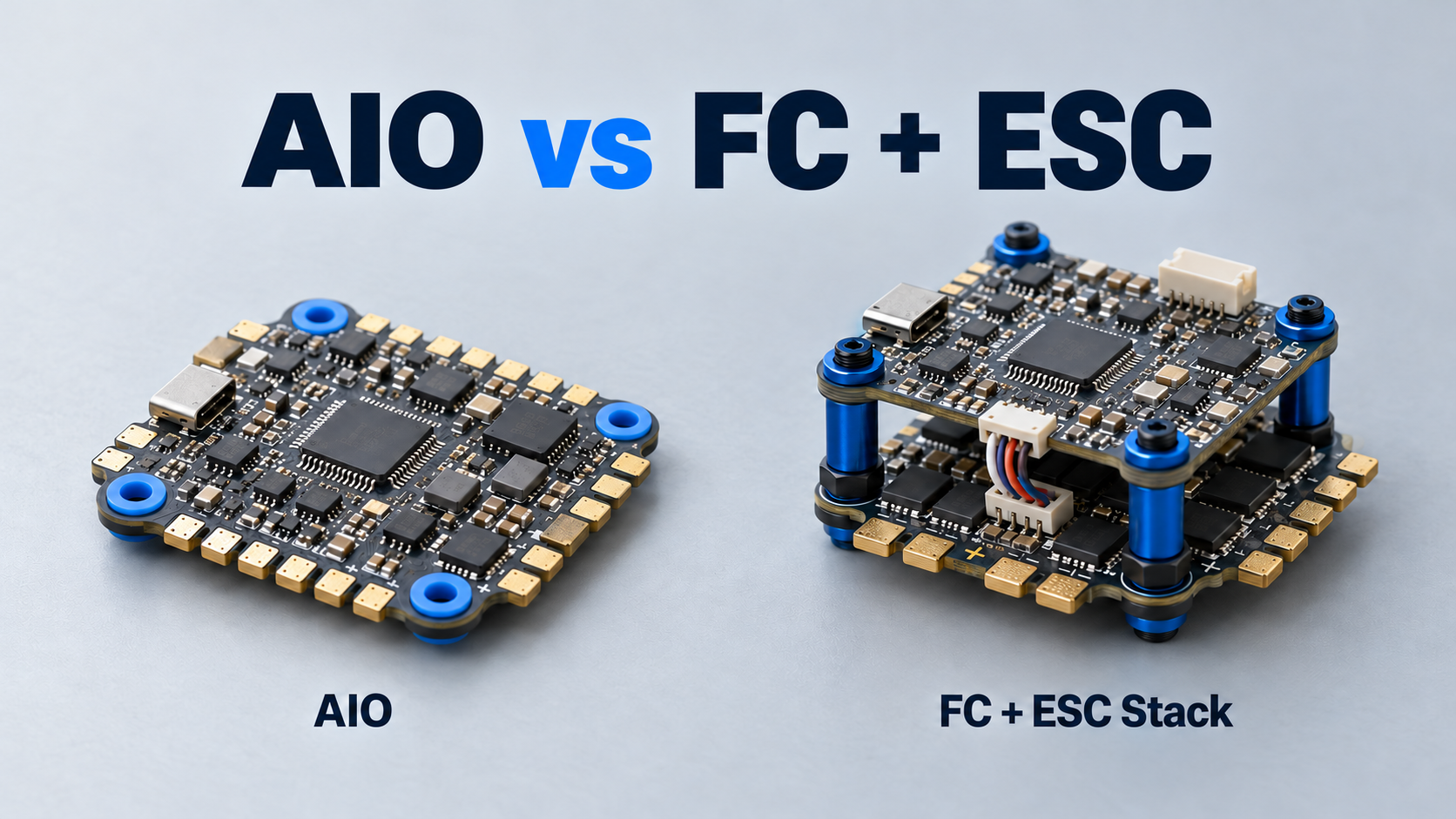
An AIO board combines the flight controller and ESC on one board. Some models also include a receiver. An FC–ESC stack uses separate flight controller and ESC boards connected by a cable. Neither format is automatically better: the specifications of the particular product must match the build.
1. Check the Space Inside Your Frame
AIO boards are often useful in compact builds because they eliminate a separate ESC board and the connection between the two. Measure the frame’s mounting pattern, available board area, and clearance before selecting one.
A stack needs room for both boards, their mounting hardware, and the connection between them. Check the assembled height as well as the mounting pattern. A frame that accepts a board’s mounting holes may still lack enough space for the complete stack.
2. Match the Battery and ESC to Your Motors
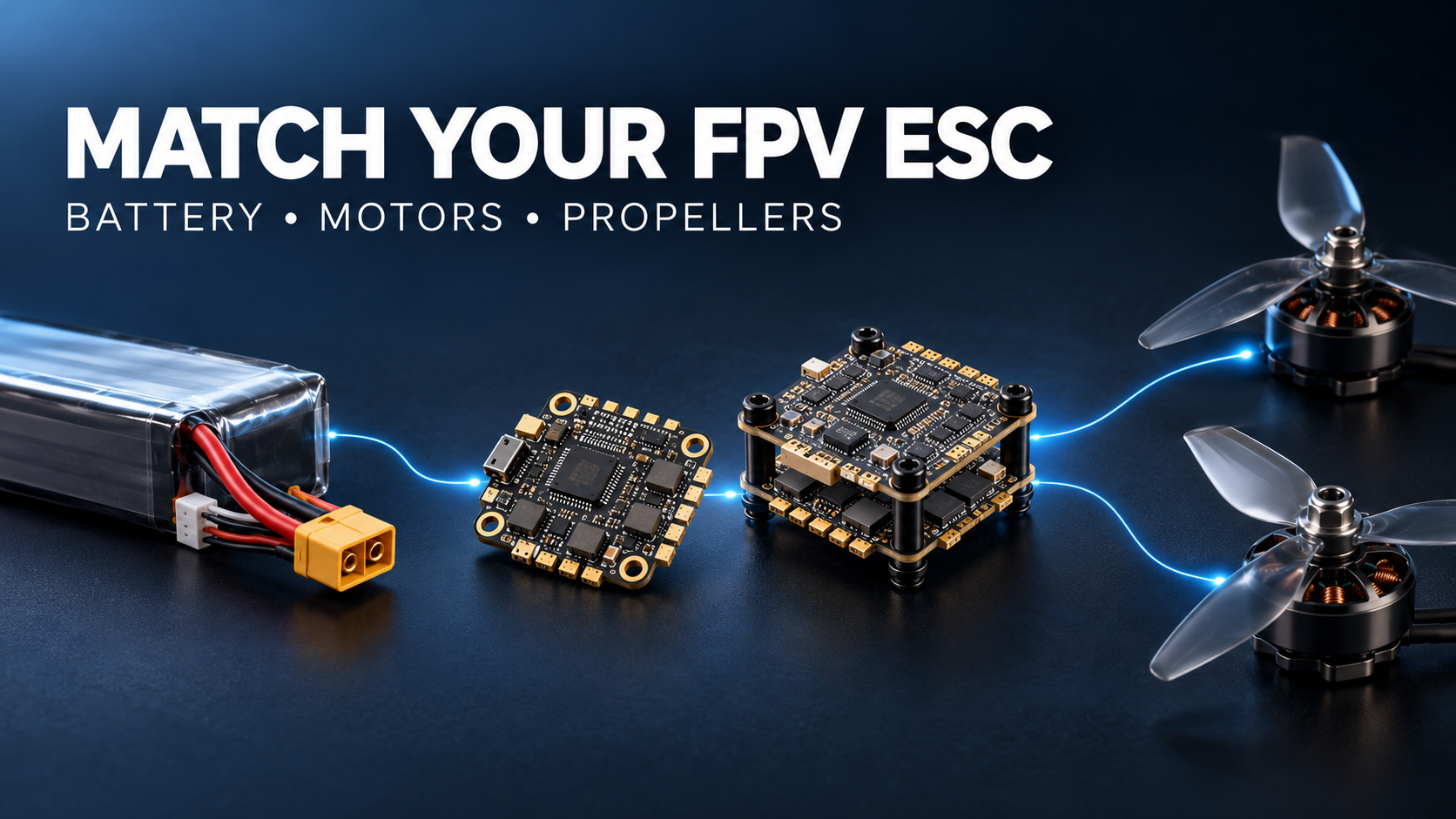
Start with the battery voltage and the current your motors may draw with your chosen propellers. Then check the ESC’s continuous current rating, not just its peak rating. Leave a suitable margin for the demands of your build.
For example, HK Corewing lists the BETAFPV F4 2–3S 20A AIO for 2S–3S builds, with a 20A continuous ESC rating. Its catalog also includes the Aocoda-RC F460 V3 stack, which supports 3S–6S and uses a 60A continuous 4-in-1 ESC. These products serve different electrical requirements; their ratings alone do not make them interchangeable options for the same drone.
3. Plan Every Connection Before Ordering
List your receiver, video system, GPS module, buzzer, LEDs, and any other devices. Confirm that the board provides the required UARTs, signal connections, and regulated power outputs. Check the voltage and current requirements of each device against the board’s available outputs.
The BETAFPV AIO includes an integrated Serial ELRS 2.4GHz receiver, which may reduce wiring when it matches your radio system. The Aocoda-RC F460 V3 stack provides receiver connections, but you must select a compatible receiver separately. Both products offer connections for additional devices, so compare their actual interfaces rather than assuming one format has more features.
4. Think About Repairs and Future Changes
An AIO can simplify assembly by combining key electronics on one board. If its flight controller or integrated ESC fails, however, replacing the complete board may be necessary.
With a stack, the flight controller and ESC are separate parts. This can make a board-level replacement more practical, provided a compatible part is available. When replacing either board, verify the connector, wiring order, voltage, and mounting dimensions before connecting it.
Which Should You Choose?
Choose an AIO when the build is compact and the board’s battery range, ESC rating, mounting pattern, receiver, and connections all meet your requirements.
Choose an FC–ESC stack when your frame has sufficient space and you want to select or replace the flight controller and ESC as separate components. Confirm that the two boards are compatible with each other and with the rest of the power system.
Before placing an order, write down five things: your frame’s mounting pattern and clearance, battery voltage, motor and propeller combination, receiver and video system, and the power requirements of every connected device. Compare that list with the complete product specifications. This short check is more reliable than choosing by board format or ESC rating alone.
Conclusion
The best FC and ESC arrangement is the one that fits your drone’s physical space and electrical requirements. HK Corewing’s catalog includes both compact AIO options and separate FC–ESC stacks. Compare the exact specifications of the product you intend to use, then confirm the complete component combination before building.