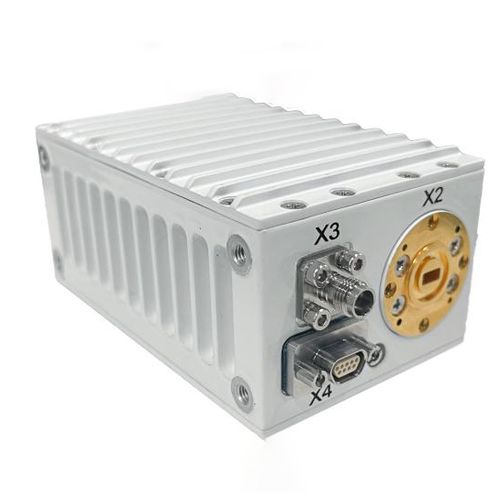

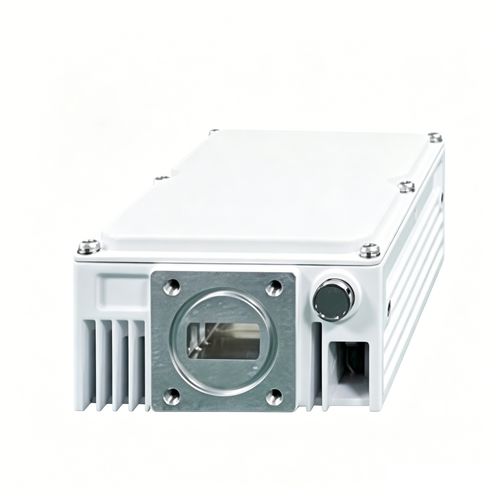
16W Ku-Band SSPB
Technical Highlights
Integrated L-Band to Ku-Band Conversion
The SSPB converts a 0.95–1.45GHz L-band input signal to the 14.0–14.5GHz Ku-band uplink range. Its integrated architecture combines frequency conversion and RF power amplification in one compact outdoor unit.
16W Rated RF Output
The amplifier provides 42dBm rated output power, equivalent to approximately 16W, with a specified linear output level of 39dBm for Ku-band satellite communication systems.
65dB Gain with Digital Adjustment
A 65dB small-signal gain supports compact uplink system design. Output level can be adjusted over a 0–20dB range in precise 0.5dB steps.
Controlled Spectral Performance
The unit specifies output spurious performance of no more than -55dBc at rated power, together with defined phase-noise, gain-flatness and noise-power-density characteristics.
Outdoor Environmental Protection
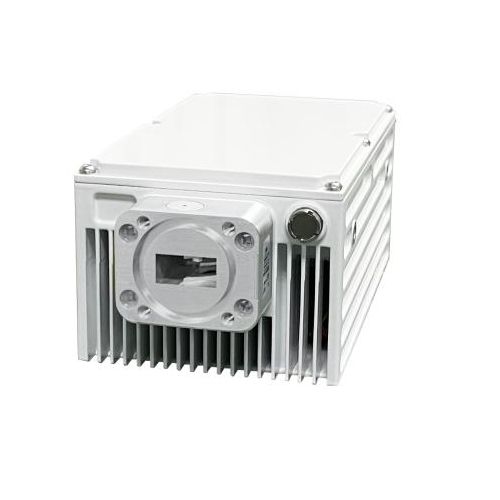
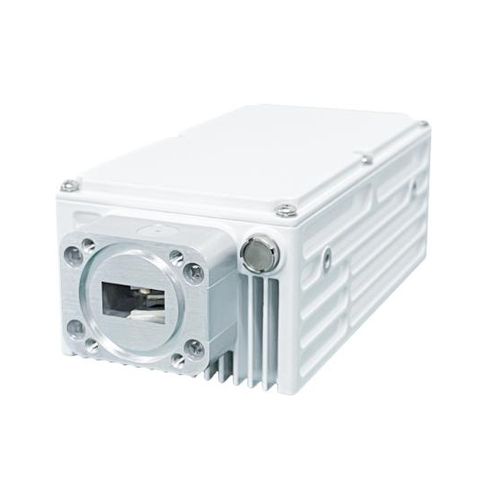
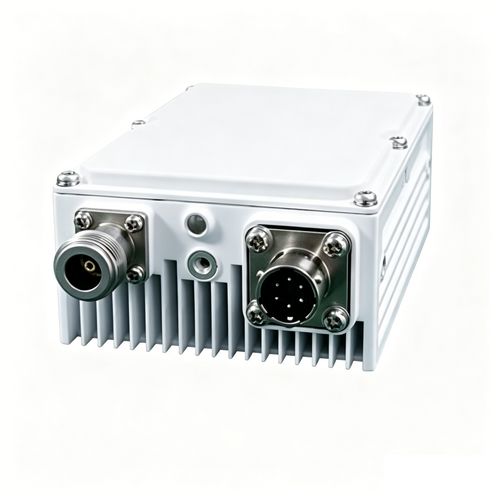
The IP66 enclosure supports outdoor deployment from -40°C to +60°C and operation in 100% condensing humidity. The aluminum housing incorporates external heat-sink fins for thermal management.
Integrated Monitoring and Control
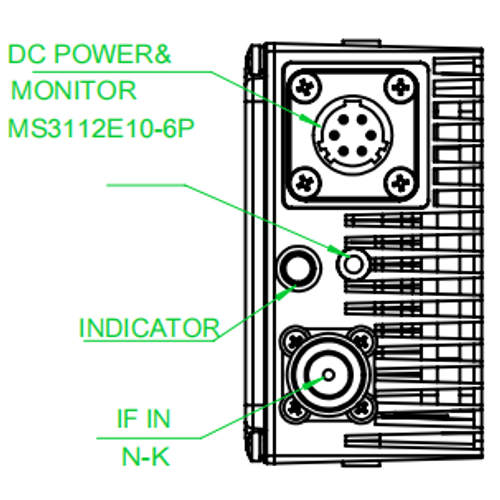
RS485 and RS422 interfaces support remote monitoring and control. A local LED displays green during normal operation and red when a fault is detected.
RF Specifications
| Output Frequency | 14.0–14.5 GHz |
|---|---|
| Input Frequency | 0.95–1.45 GHz |
| LO Frequency | 13.05 GHz |
| Rated Output Power | 42 dBm, approximately 16W |
| Linear Output Power | 39 dBm |
| Small Signal Gain | 65 dB |
| Gain Adjustment | 0–20 dB in 0.5 dB steps |
| Reference Frequency | External 10MHz, 0dBm ±5dB |
| Input VSWR | ≤1.5:1 |
| Output VSWR | ≤1.5:1 |
| Output Spurious at Rated Power | ≤-55 dBc |
| Phase Noise | -63 dBc/Hz at 100Hz -73 dBc/Hz at 1kHz -83 dBc/Hz at 10kHz -93 dBc/Hz at 100kHz |
| Gain Variation over 40MHz | 1.2 dB p-p |
| Gain Variation over 500MHz | 3.0 dB p-p |
| Gain Variation over Temperature | 2.0 dB p-p |
| IM3 | -25 dBc at Plin with two tones 5MHz apart |
| Noise Power Density at 14.0–14.5GHz | ≤-70 dBW/4kHz |
| Noise Power Density at 10.7–12.75GHz | ≤-145 dBW/4kHz |
Interfaces
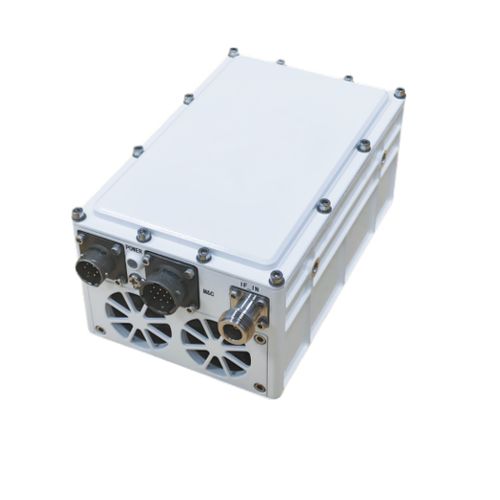
| IF Input | N-K connector, 50Ω |
|---|---|
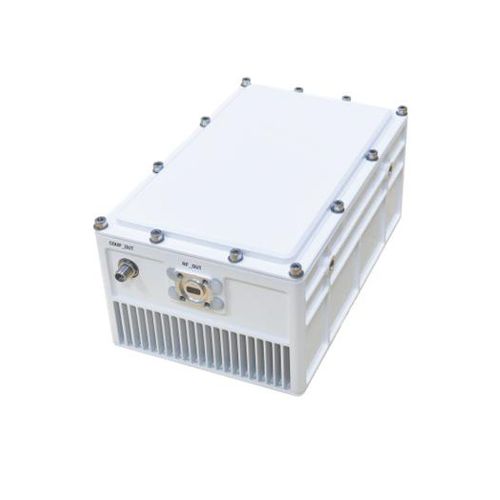
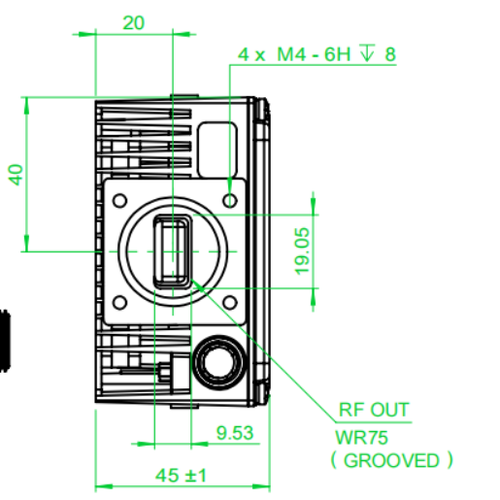
| RF Output | WR-75 grooved waveguide flange |
| DC and M&C Connector | 6-pin circular connector, MS3112E10-6P |
| Monitor and Control | RS485 / RS422 |
| Status Indicator | Green: normal operation; red: fault |
Physical and Environmental Specifications
| Power Supply | 18–72V DC |
|---|---|
| Power Consumption | 80W at rated output power |
| Outline Dimensions | 110 × 80 × 45mm (4.3 × 3.1 × 1.8in) |
| Weight | 0.65kg (1.43lb) |
| Operating Temperature | -40°C to +60°C (-40°F to +140°F) |
| Storage Temperature | -50°C to +80°C (-67°F to +176°F) |
| Ingress Protection | IP66 |
| Humidity | 100% condensing |
Recommended Applications
Ku-band satellite communication uplink terminals
Compact fixed and transportable earth stations
VSAT transmission systems
Emergency and remote-site satellite communication links
OEM satellite terminal integration
Ku-band RF test and communication systems
Integration Notes
Provide an external 10MHz reference at the specified 0dBm ±5dB level.
Use an 18–72V DC supply with sufficient capacity for the specified 80W power consumption.
Confirm the MS3112E10-6P connector pinout before applying power or connecting monitoring equipment.
Align the WR-75 waveguide flange correctly and use suitable sealing hardware for outdoor installation.
Keep the heat-sink surfaces unobstructed and provide adequate airflow around the enclosure.
Verify that the purchase order identifies the 16W version, because the source specification also covers a 25W model.
Confirm the required L-band input range before ordering if a frequency option other than 0.95–1.45GHz is required.
FAQ
What is the 16W Ku-Band SSPB?
It is a solid-state power block upconverter that converts a 0.95–1.45GHz L-band input signal to the 14.0–14.5GHz Ku-band uplink range and provides approximately 16W of rated RF output.
What is the rated output power?
The rated output power is 42dBm, which is approximately 16W. The specified linear output level is 39dBm.
What input frequency does the SSPB support?
The standard input-frequency specification used for this model is 0.95–1.45GHz. Confirm the required input range before ordering if a different L-band option is needed.
What is the Ku-band output-frequency range?
The RF output operates from 14.0GHz to 14.5GHz with a specified local-oscillator frequency of 13.05GHz.
Can the gain be adjusted?
Yes. The unit provides a gain-adjustment range of 0–20dB in 0.5dB steps. Its specified small-signal gain is 65dB.
Does the unit require an external reference?
Yes. The specification lists an external 10MHz reference input with a nominal level of 0dBm and an allowable variation of ±5dB.
Which RF connectors are used?
The L-band IF input uses an N-K 50Ω connector. The Ku-band RF output uses a WR-75 grooved waveguide flange.
Which monitoring interfaces are supported?
The unit supports RS485 and RS422 monitoring and control through the circular DC and M&C connector.
What do the LED colors indicate?
A green LED indicates normal operation, while a red LED indicates that the unit has detected a fault condition.
What power supply is required?
The SSPB accepts an 18–72V DC input and consumes approximately 80W when operating at rated output power.
Can the SSPB be installed outdoors?
Yes. The enclosure is rated IP66 and supports operation from -40°C to +60°C in environments with up to 100% condensing humidity. Correct sealing and thermal installation remain necessary.
What installation checks are required?
Verify the DC connector pinout, supply voltage, 10MHz reference level, WR-75 flange alignment, weather sealing and available heat-sink airflow before operation.
B2B Procurement FAQ
What information should be included in a quotation request?
Include the required quantity, output power, input-frequency range, output-frequency range, DC supply, monitoring interface, destination country and requested delivery schedule.
How should buyers distinguish the 16W and 25W versions?
The 16W version is specified at 42dBm rated output, 39dBm linear output and 80W power consumption. Buyers should include these values and the 16W designation in the purchase order.
Can different input-frequency options be requested?
The standard value used on this product page is 0.95–1.45GHz. Any alternative L-band input range must be confirmed during quotation and documented in the final technical specification.
Are sample units available for system evaluation?
Sample-unit availability, price and delivery time should be confirmed during quotation. Buyers should provide the intended terminal configuration and test requirements.
Which inspections are recommended before shipment?
Recommended inspections include output-power testing, gain and gain-adjustment verification, frequency conversion, VSWR, reference locking, monitoring communication, LED status and DC power-consumption checks.
Which mechanical checks should be included?
Check the enclosure dimensions, connector condition, WR-75 flange, mounting threads, heat-sink surfaces, sealing condition, product labeling and package protection.
Which documents should bulk buyers request?
Request the latest specification sheet, mechanical drawing, connector pinout, monitoring protocol, inspection report, packing list and applicable compliance documents.
Can labeling or packaging be customized?
Labeling, documentation and packaging requirements can be submitted with the RFQ. Availability, minimum quantity and production requirements must be confirmed before ordering.
How are lead time and warranty confirmed?
Lead time and warranty terms depend on order quantity, selected configuration and production schedule. They should be stated in the final quotation or supply agreement.