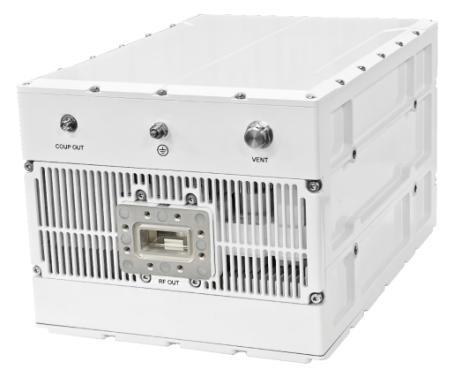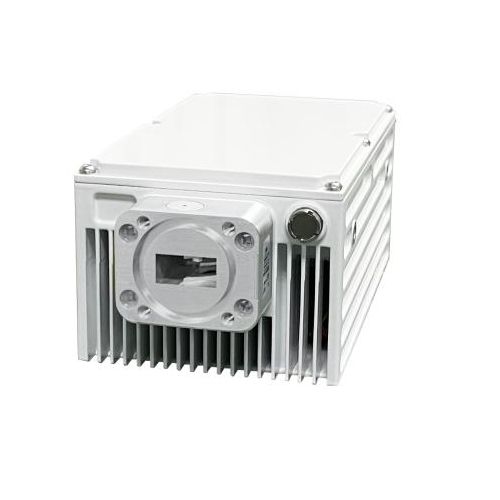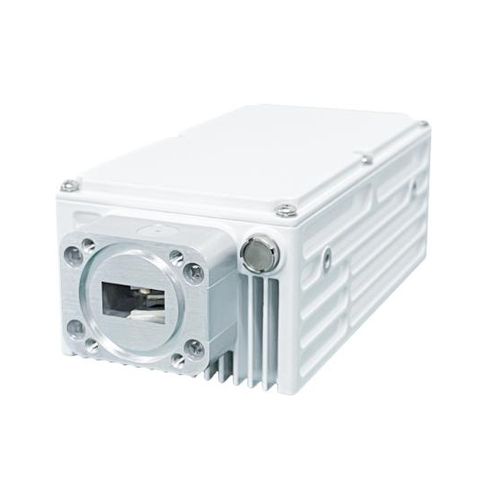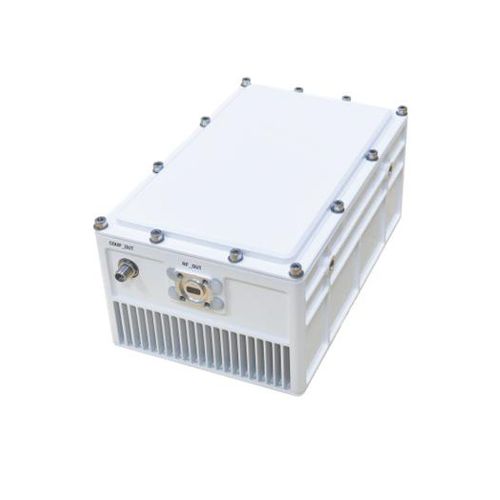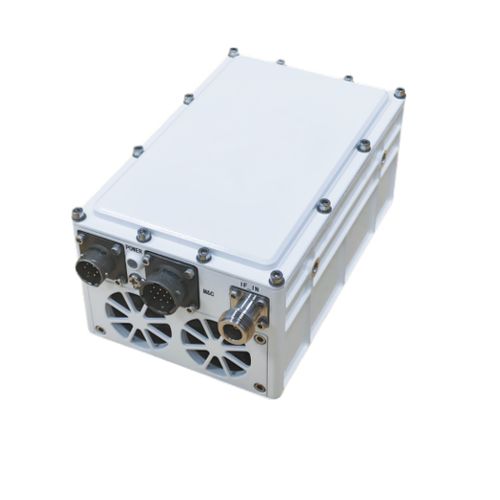

100W Ka-Band SSPB
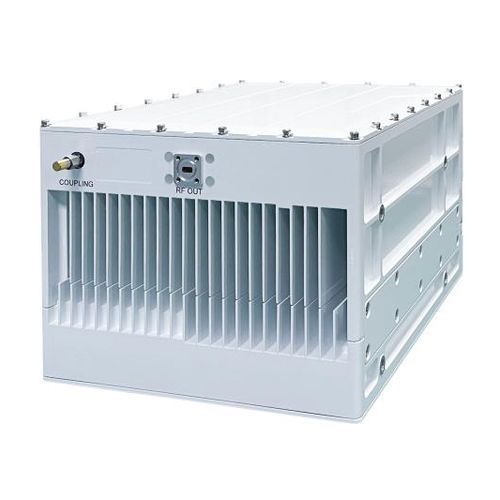
Technical Highlights
Four Ka-Band Frequency Options
The SSPB is available in four output-frequency versions covering ranges from 27.50 to 31.00GHz. Each version converts a 950–1950MHz L-band input using its corresponding local oscillator frequency.
100W Rated RF Output
The unit provides 50dBm, equivalent to 100W, of rated RF output power and 47dBm of linear output power.
70dB Gain with Fine Adjustment
A small-signal gain of 70dB is combined with a 0–20dB adjustment range in precise 0.25dB steps.
Internal and External Reference Support
The unit supports a 10MHz external reference at 0dBm ±5dB and an internal reference with stability of ≤±0.1ppm over temperature. Automatic reference switching is specified.
Outdoor Monitoring and Control
The IP66 enclosure supports RS485/RS422 and Ethernet monitoring through SNMP and HTTP, with separate green normal-status and red fault-status indication.
Frequency Configuration
| Band Version | Output Frequency | LO Frequency |
|---|---|---|
| Band 1 | 27.50–28.50GHz | 26.55GHz |
| Band 2 | 28.25–29.25GHz | 27.3GHz |
| Band 3 | 29.00–30.00GHz | 28.05GHz |
| Band 4 | 30.00–31.00GHz | 29.05GHz |
| Input Frequency | 950–1950MHz | |
RF Specifications
| Rated Output Power | 50dBm, 100W |
|---|---|
| Linear Output Power | 47dBm |
| Small Signal Gain | 70dB |
| Gain Adjustment | 0–20dB in 0.25dB steps |
| 10MHz External Reference | 0dBm ±5dB |
| Internal Reference Stability | ≤±0.1ppm over temperature |
| Phase Noise | −63dBc/Hz at 100Hz; −73dBc/Hz at 1kHz; −83dBc/Hz at 10kHz; −93dBc/Hz at 100kHz |
| Output Spurious at Rated Power | ≤−55dBc |
| Gain Variation over 40MHz | 1.2dB p-p |
| Gain Variation over 500MHz | 3.5dB p-p |
| Gain Variation over Full Band | 4.0dB p-p |
| Gain Variation over Temperature | 3.0dB p-p |
| IM3 | −25dBc at linear output power with dual tones 5MHz apart |
| Noise Power Density at 27.5–31.0GHz | ≤−70dBW/4kHz |
| Noise Power Density at 17.7–21.2GHz | ≤−145dBW/4kHz |
Power and Environmental Specifications
| Power Supply | 220VAC, operating range 176–264V, 50–60Hz |
|---|---|
| Power Consumption | 860W at rated output power |
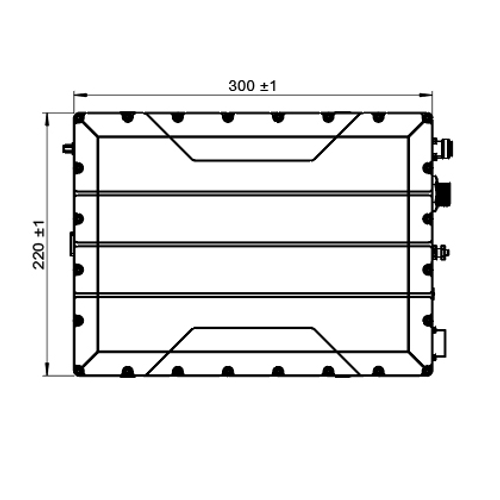
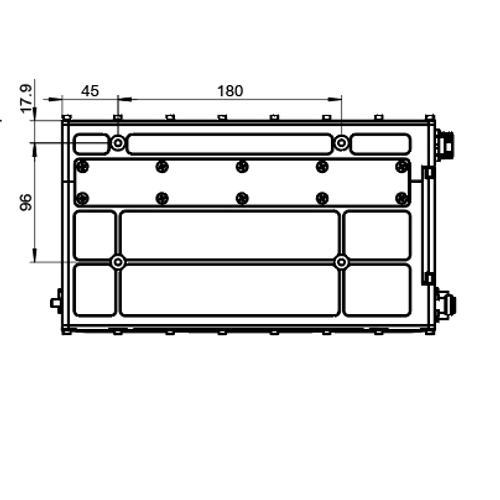
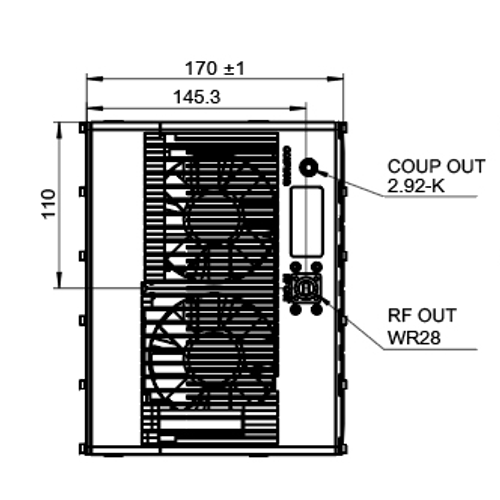
| Outline Dimensions | 300 × 220 × 170mm (11.8 × 8.66 × 6.69in) |
| Weight | 11kg (24.25lb) |
| Operating Temperature | −40 to +60°C (−40 to +140°F) |
| Storage Temperature | −50 to +80°C (−58 to +176°F) |
| Ingress Protection | IP66 |
| Humidity | 100% condensing |
Interfaces
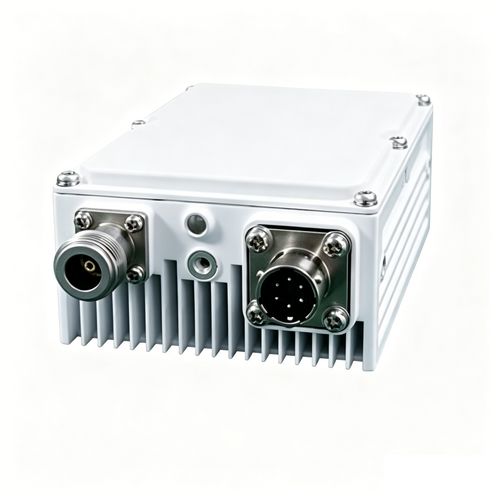
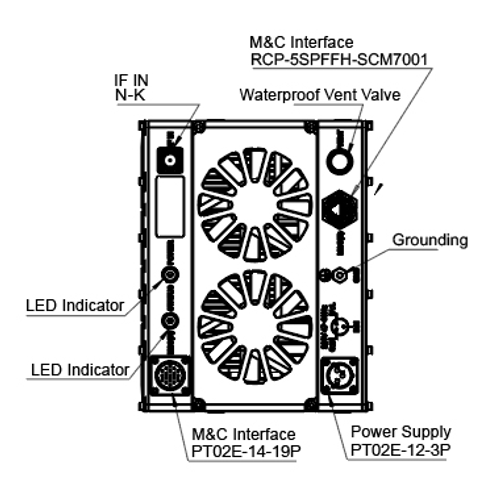
| IF Input Interface | N-K, 50Ω |
|---|---|
| Input VSWR | ≤1.5:1 |
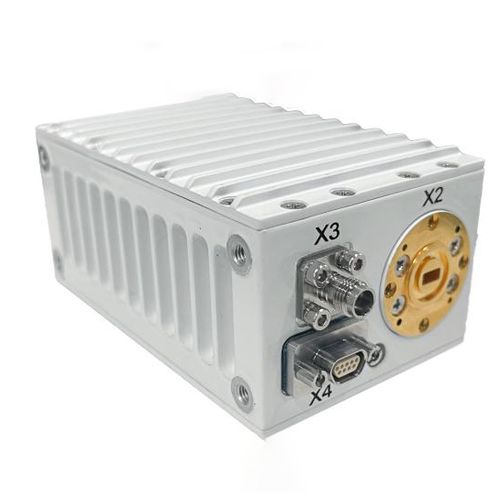
| RF Output Interface | WR-28 grooved waveguide |
| Output VSWR | ≤1.3:1 |
| Coupling Interface | 2.92mm-K |
| Power Interface | 3-pin circular connector; PT02E-12-3P shown in the mechanical drawing |
| M&C Interface | 19-pin circular connector and RJ45; PT02E-14-19P shown in the mechanical drawing |
| Monitor and Control | RS485/RS422; Ethernet with SNMP and HTTP |
| LED Status Indicator | Green for normal operation; red for fault status |
Recommended Applications
High-power Ka-band satellite uplink terminals
Satellite ground stations and gateway systems
Outdoor block upconverter installations
Ka-band communication system integration
Integration Notes
Select the required output-frequency version before ordering.
Verify compatibility with the WR-28 grooved waveguide interface.
Provide a 176–264V AC source capable of supporting 860W consumption at rated output power.
Provide protective grounding through the identified grounding point.
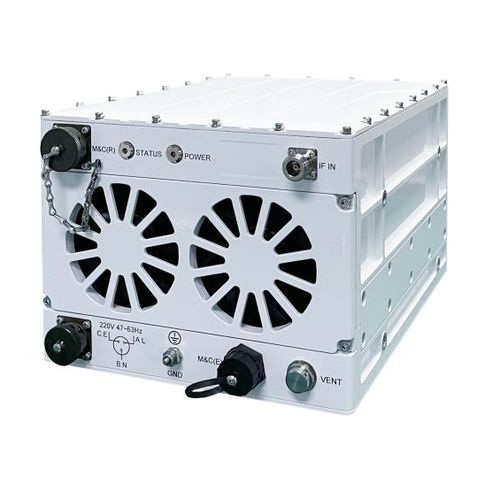
Allow adequate clearance around the cooling fins, fans and waterproof vent valve.
Confirm the required RS485, RS422, SNMP or HTTP monitoring method during system integration.
FAQ
What is the 100W Ka-Band SSPB?
It is a solid-state power block upconverter that converts a 950–1950MHz L-band input into a Ka-band RF output while providing 50dBm, equivalent to 100W, of rated output power.
Which Ka-band output frequencies are available?
Four versions are specified: 27.50–28.50GHz, 28.25–29.25GHz, 29.00–30.00GHz and 30.00–31.00GHz.
Does one unit cover the complete 27.50–31.00GHz range?
No continuous full-band operation is specified. The documentation identifies four output-frequency versions, so the required range should be selected before ordering.
What is the input frequency?
The specified IF input-frequency range is 950–1950MHz.
What are the rated and linear output powers?
The SSPB provides 50dBm, equivalent to 100W, of rated output power and 47dBm of linear output power.
Can the gain be adjusted?
Yes. The unit provides a 0–20dB adjustment range in 0.25dB steps, with 70dB specified small-signal gain.
Does the SSPB support an external reference?
Yes. It supports a 10MHz external reference at 0dBm ±5dB. The internal reference has stability of ≤±0.1ppm over temperature, and automatic reference switching is specified.
What RF interfaces are used?
The IF input uses an N-K 50Ω interface, the RF output uses a WR-28 grooved waveguide, and the coupled output uses a 2.92mm-K interface.
What AC power input is required?
The formal specification states 220VAC with a 176–264V operating range and a frequency of 50–60Hz.
What is the power consumption?
The specified power consumption is 860W at rated RF output power.
Which monitoring interfaces are available?
The unit provides a 19-pin circular monitoring connector and RJ45 interface, with RS485/RS422 and Ethernet monitoring through SNMP and HTTP.
Is the SSPB suitable for outdoor installation?
The enclosure is rated IP66 and supports operation from −40 to +60°C with 100% condensing humidity.
What are the dimensions and weight?
The dimensions are 300 × 220 × 170mm, and the specified weight is 11kg.
B2B Procurement FAQ
What information should be included in an RFQ?
Please specify the required output-frequency band, quantity, AC supply conditions, monitoring interface and system-level connector requirements.
How should the output-frequency version be selected?
Select one of the four specified ranges according to the required satellite uplink frequency plan: 27.50–28.50GHz, 28.25–29.25GHz, 29.00–30.00GHz or 30.00–31.00GHz.
Should the RFQ identify this as the 100W version?
Yes. The RFQ should state 50dBm rated output power, 47dBm linear output power and 860W power consumption to identify the required 100W configuration.
Which AC frequency should be used for procurement?
The formal specification states 50–60Hz, while a product photograph shows 47–63Hz. The required AC input-frequency range should be confirmed during quotation.
Can an evaluation unit be requested?
Evaluation-unit availability is not stated in the supplied documentation and must be confirmed during quotation.
Which specifications should be verified during incoming inspection?
Recommended checks include output-frequency version, input frequency, rated and linear output power, gain adjustment, VSWR, reference input, AC supply, RF interfaces and monitor-and-control communication.
Can protocol and interface documents be requested?
The applicable RS485, RS422, SNMP or HTTP documentation should be requested and confirmed before system integration.
Can packaging or identification labels be specified?
Packaging, product identification and labeling requirements are not stated in the supplied material and must be confirmed during quotation.
How are MOQ, lead time, warranty and delivery terms confirmed?
These commercial terms are not provided in the supplied documentation and must be confirmed in the supplier quotation.