

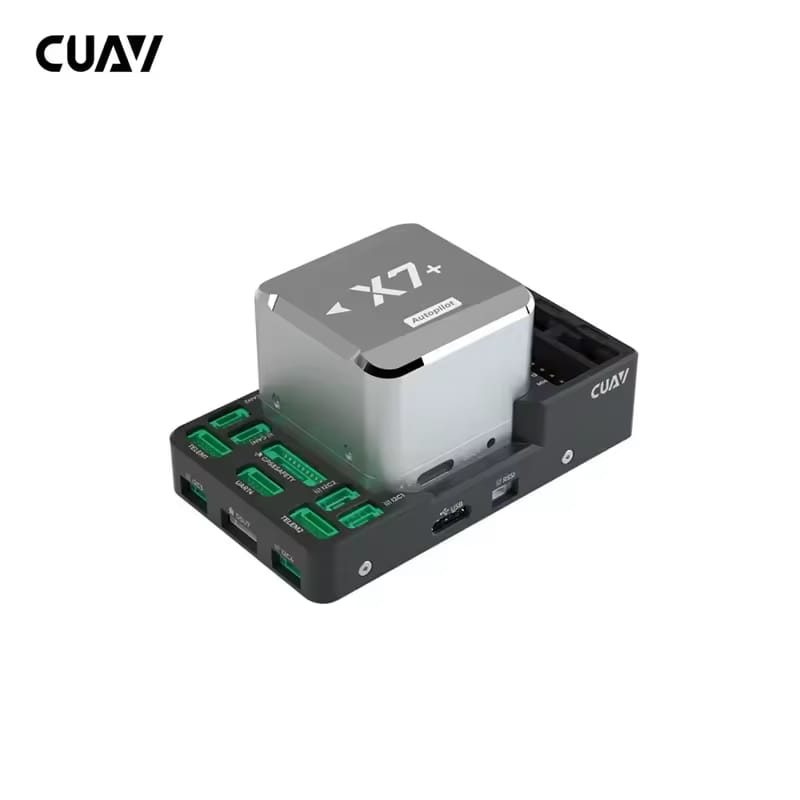
CUAV X7+ Pro Autopilot Flight Controller
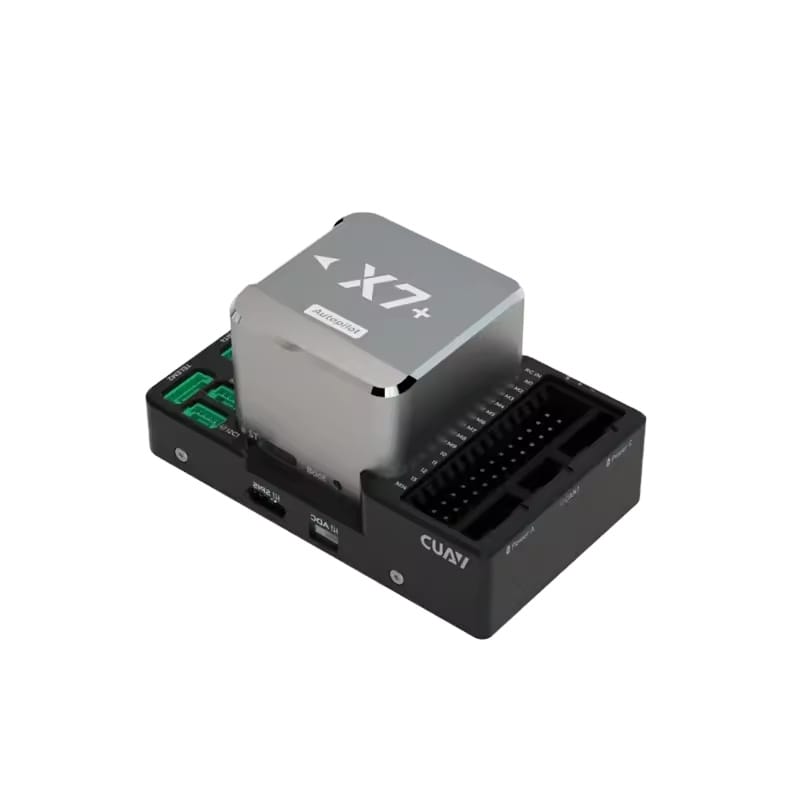
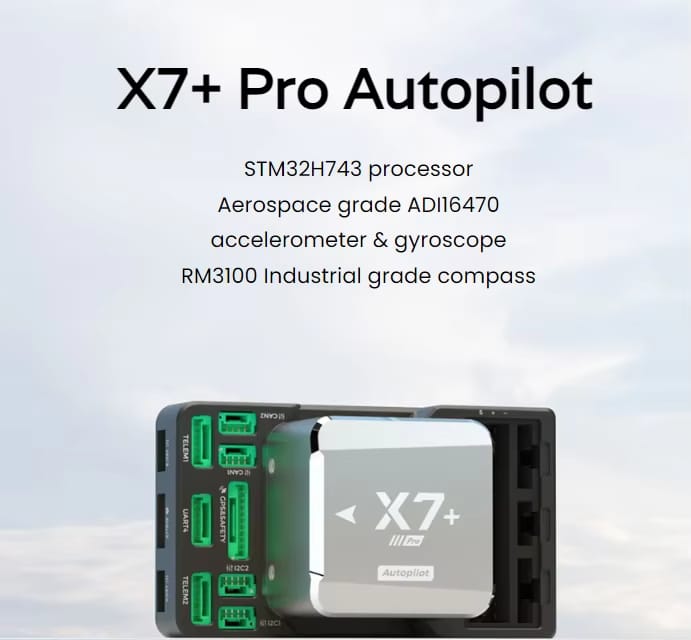
Technical Highlights
STM32H743 Processing Platform
The CUAV X7+ Pro uses an STM32H743 processor operating at up to 480MHz with double-precision floating-point support, 2MB Flash and 1MB RAM for advanced UAV flight-control applications.
Triple-Redundant IMU Architecture
Three independent IMUs combine an automotive-grade ADIS16470 with ICM42688-P and ICM20689-P sensors. The redundant architecture supports sensor monitoring and fault switching during operation.
Dual Barometers and Industrial Magnetometer
Two MS5611 barometers provide pressure-sensing redundancy, while the industrial-grade RM3100 magnetometer offers strong resistance to magnetic interference.
Temperature Compensation and Internal Vibration Isolation
Integrated sensor temperature compensation and CUAV internal shock-absorption construction help maintain stable sensor performance across changing temperatures and vibration conditions.
ArduPilot and PX4 Support
The controller supports ArduPilot and PX4 open-source autopilot firmware for multirotors, fixed-wing aircraft, helicopters, VTOL platforms, rovers and other unmanned systems.
Expandable Industrial Interfaces
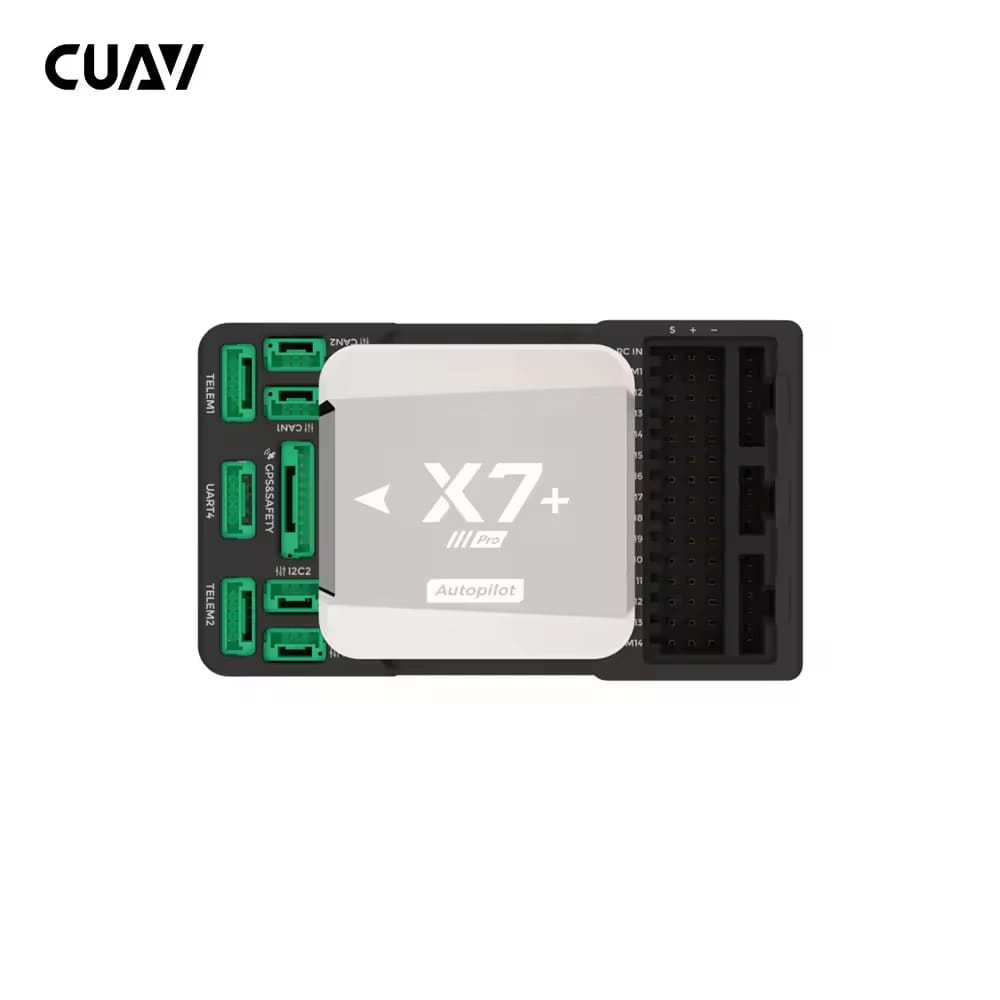
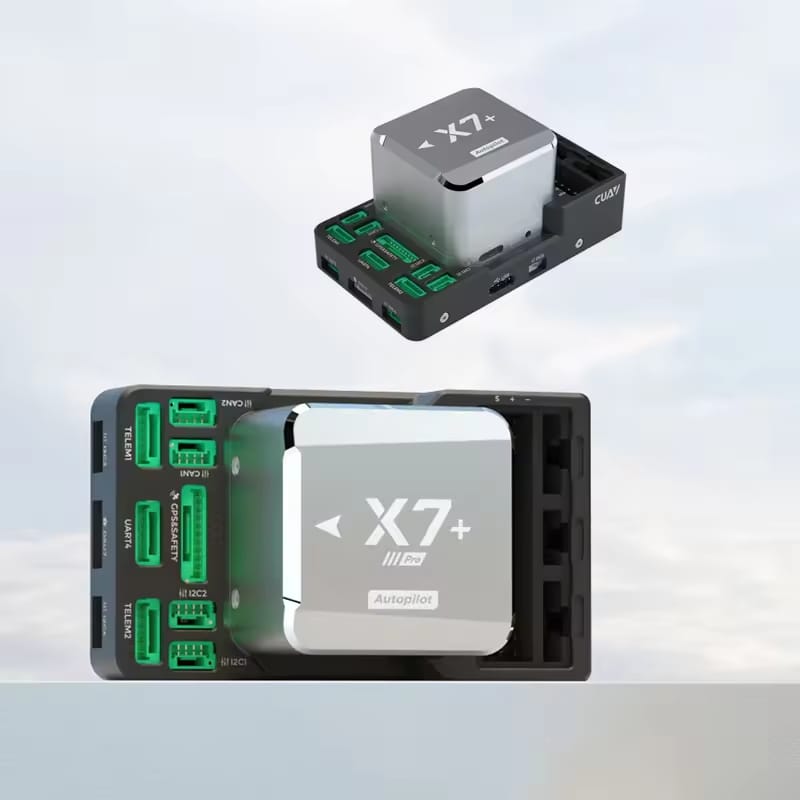
Dual CAN buses, six I2C buses, two GPS connections, fourteen PWM outputs, dual power inputs and modular carrier-board construction support complex UAV system integration.
Controller Specifications
| Product Name | CUAV X7+ Pro Autopilot Flight Controller |
|---|---|
| Controller Type | Industrial modular autopilot controller |
| Main Processor | STM32H743, up to 480MHz |
| Processor Memory | 2MB Flash and 1MB RAM |
| IMU 1 | ADIS16470 gyroscope and accelerometer |
| IMU 2 | ICM42688-P gyroscope and accelerometer |
| IMU 3 | ICM20689-P gyroscope and accelerometer |
| Barometers | Two MS5611 barometers |
| Magnetometer | RM3100 industrial-grade magnetometer |
| Sensor Redundancy | Three IMUs with sensor monitoring and fault switching |
| Temperature Compensation | Supported |
| Vibration Isolation | Integrated CUAV internal shock-absorption system |
| Firmware | ArduPilot and PX4 |
| ArduPilot Target | CUAV-X7 |
| PX4 Target | cuav_x7pro_default |
Interfaces
| PWM Outputs | 14 outputs; 12 support DShot |
|---|---|
| RC Inputs | SBUS, PPM and DSM |
| RSSI Input | Analog and PWM RSSI supported |
| GPS Ports | 2, through the GPS and UART4 interfaces |
| I2C Buses | 6 total: four independent I2C interfaces plus two integrated into the GPS and UART4 interfaces |
| CAN Bus Ports | 2 |
| Power Ports | 2: Power A for conventional ADC power modules and Power C for DroneCAN power modules |
| ADC Inputs | 2 |
| USB | 1 USB Type-C port |
| Debug Interface | DSU7 serial console and SWD interface |
| Carrier Board | Modular design with support for compatible custom carrier boards |
Electrical Specifications
| Controller Power Input | 4.5–5.4V through Power A or Power C |
|---|---|
| USB Input | 4.75–5.25V |
| Servo Rail Input | 0–10V |
| Servo Rail Monitoring | Supported on X7+ Pro |
| Power Priority | Power A or Power C first, followed by USB input |
| RCIN Power Limitation | RCIN may power an RC receiver only and must not be used for other electrical loads |
Physical and Environmental Specifications
| Dimensions | Approximately 77 × 45.5 × 39 mm |
|---|---|
| Weight | Approximately 101 g |
| Operating Temperature | −20°C to 85°C |
| Construction | Modular controller and carrier-board assembly with internal vibration isolation |
Recommended Applications
Industrial multirotor UAVs
Fixed-wing unmanned aircraft
VTOL aircraft
Unmanned helicopters
Autonomous rover platforms
Research and secondary-development projects based on ArduPilot or PX4
UAV systems requiring redundant sensors, CAN peripherals and multiple navigation interfaces
Installation and Selection Notes
Flash the correct firmware before operation: CUAV-X7 for ArduPilot or cuav_x7pro_default for PX4.
Back up parameters before changing or updating firmware.
The PWM servo rail does not power the controller. Supply the controller through Power A, Power C or USB.
Do not connect additional electrical loads to the RCIN receiver-power output.
Confirm that servo-rail voltage does not exceed 10V.
Check the selected GNSS interface before ordering. NEO 3 UART and NEO 3 Pro DroneCAN modules use different interfaces.
GPS, power modules, CAN expansion boards, LTE Link modules and cables may vary by package configuration.
Use appropriate vibration isolation, power distribution and electromagnetic separation for the intended aircraft.
FAQ
What is the difference between X7+ Pro and X7 Pro?
X7+ Pro replaced X7 Pro and adds servo-rail voltage monitoring with a maximum servo-rail input of 10V. The X7+ Pro sensor configuration must also be distinguished from earlier X7 Pro hardware.
Which IMUs are installed in the X7+ Pro?
The official X7+ Pro configuration uses ADIS16470, ICM42688-P and ICM20689-P gyroscope and accelerometer sensors.
Which firmware does the controller support?
The controller supports ArduPilot and PX4 open-source autopilot firmware.
Which firmware target should be selected?
Use CUAV-X7 for ArduPilot. For PX4, use the cuav_x7pro_default firmware target supplied for X7+ Pro and X7 Pro.
Does the controller arrive ready to fly?
The manufacturer states that compatible firmware must be flashed before normal operation. Aircraft parameters and safety settings must then be configured for the intended platform.
How many PWM outputs are available?
The controller provides 14 PWM outputs, of which 12 support DShot.
What is the main controller input voltage?
The controller accepts 4.5–5.4V through Power A or Power C. USB input is specified at 4.75–5.25V.
Does X7+ Pro include an integrated OSD chip?
The supplied and official specifications do not identify an integrated analog OSD chip. OSD functions depend on the selected firmware and compatible external video equipment.
Is a GPS module included?
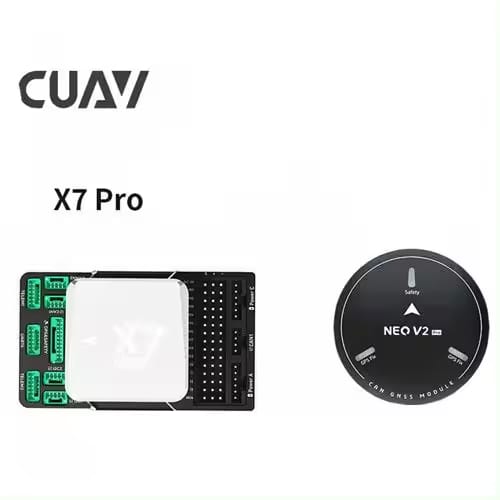
The product files show several GPS options, including NEO 3 and NEO V2-series configurations. The exact GPS model and its inclusion depend on the selected package.
Can the X7+ Pro be used for fixed-wing or VTOL aircraft?
Yes. Compatible ArduPilot and PX4 firmware supports multirotors, fixed-wing aircraft, helicopters, VTOL platforms and rover applications.
B2B Procurement FAQ
What exact model should be stated on a purchase order?
Specify CUAV X7+ Pro Autopilot Flight Controller with STM32H743, triple IMUs and RM3100 magnetometer. Do not shorten the model to X7 Pro or X7+.
How can buyers avoid receiving the earlier X7 Pro version?
State X7+ Pro explicitly and request confirmation of the model label, sensor configuration and servo-rail voltage-monitoring function before the order is finalized.
Which GPS option should be specified?
Specify the required GPS model and interface separately. NEO 3 uses a UART connection, while NEO 3 Pro uses DroneCAN. M8N V2-series and other GPS options should not be treated as equivalent without confirmation.
Are the GPS, CAN PMU and expansion board included?
The archive contains several product and package configurations. Confirm whether the quotation includes the flight controller only or a bundle with GNSS, power module, cables and expansion hardware.
What should be checked during incoming inspection?
Verify the X7+ Pro model label, processor and sensor configuration, carrier board, connector condition, supplied cables, power module, GNSS model and other quoted accessories.
Should firmware be installed before delivery?
The required ArduPilot or PX4 firmware, target, vehicle type and parameter configuration should be confirmed during quotation. Firmware should not be installed using an unrelated target.
Are the LTE Link and communication modules included?
LTE Link equipment shown in the supplied marketing images is an optional communication product. Its inclusion must be confirmed separately.
Are MOQ, lead time, packaging and available quantity fixed?
MOQ, lead time, packaging, available quantity and exact bundle contents must be confirmed during quotation.
Leave Your Message
Products categories
-
ZMR NX4 EVO Fixed-Wing Gyro Flight Contr
-
ZMR NX4 PRO Fixed-Wing Gyro Flight Contr
-
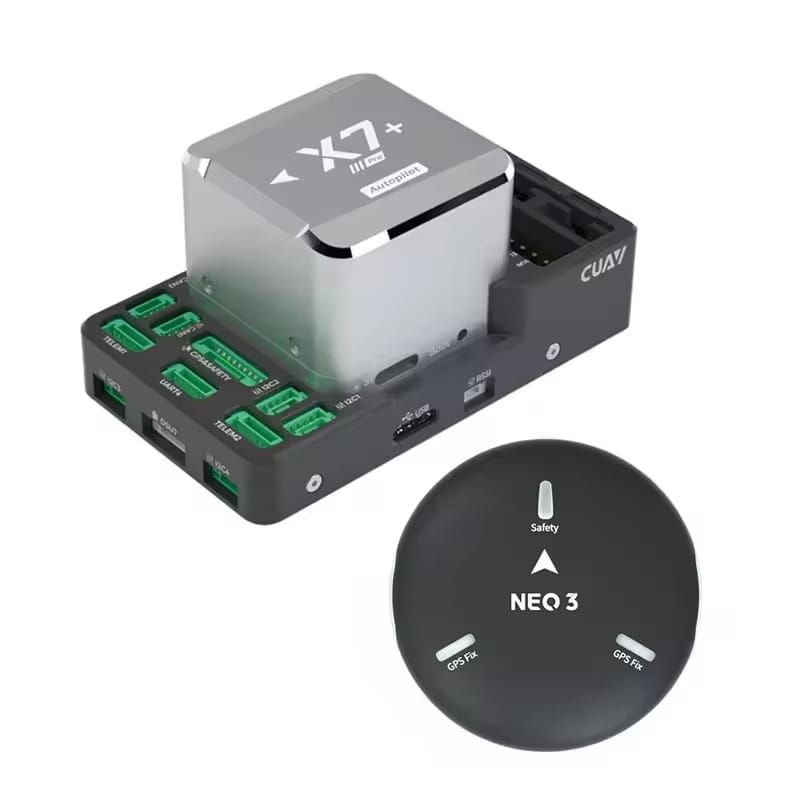
CUAV X7+ Pro Autopilot Flight Controller
-
RadioLink F722 Betaflight Flight Control
-
SpeedyBee F405 V5 OX32 55A FPV Stack
-
SpeedyBee F405 V4 BLS 60A FPV Stack
-
SoloGood F722 V1.0 60A FPV Stack
-
SIYI N7 H7 Autopilot Flight Controller
-
SpeedyBee F7 Mini 35A BLHeli_S Stack
-
RadioLink CrossFlight V1.0 Flight Contro