

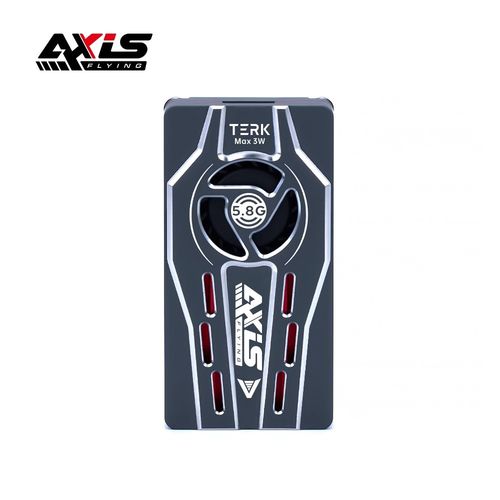
Axisflying TERK 5.8G Max 3W Analog VTX
Technical Highlights
Up to 3.0W Adjustable Output
The TERK analog video transmitter provides PIT, 25mW, 400mW, 600mW, 1.6W, and 3.0W operating modes. Multiple output settings allow the transmitter to be configured for different test, installation, and flight requirements.
Extended 56-Channel Frequency Plan
This version supports seven frequency bands with eight channels per band. Its listed frequency plan covers 4990–5945 MHz across the A, B, E, F, R, L, and X bands.
Active Cooling for High-Power Operation
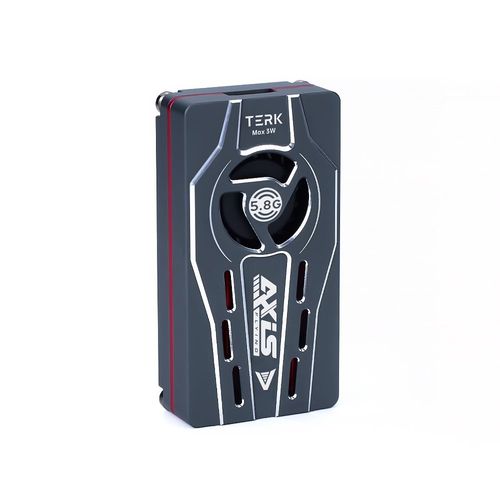
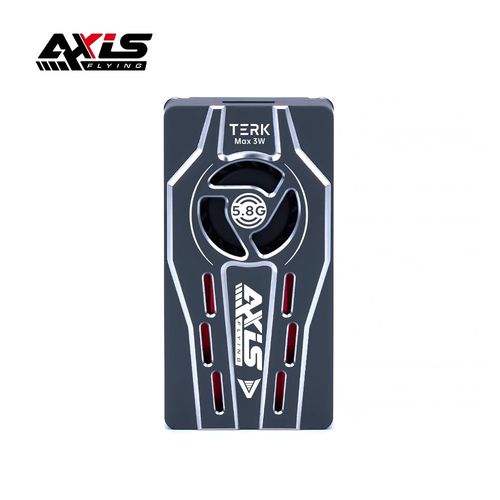
A CNC aluminum heat sink and built-in cooling fan help remove heat from the transmitter during sustained operation. Cooling openings should remain unobstructed when the VTX is installed.
Button and IRC Tramp Control
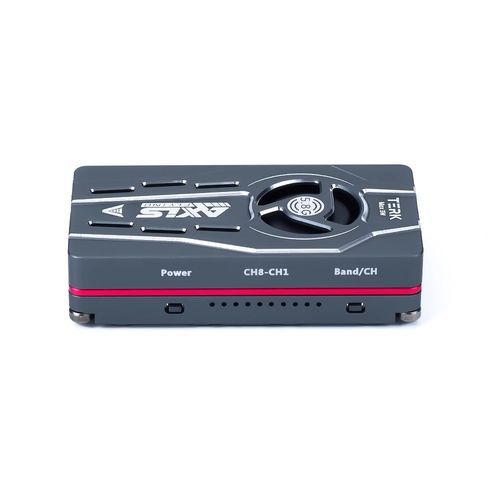
Power, band, and channel settings can be changed using the onboard buttons. The DATA connection also supports IRC Tramp control from a compatible flight controller.
Analog Video with Built-In Microphone
The transmitter is designed for analog FPV video systems and includes a built-in microphone, LED status indicators, a video input, and a 5V output connection.
RF and Electrical Specifications
| Product Model | Axisflying TERK 5.8G Max 3W VTX |
|---|---|
| Video System | Analog FPV video transmission |
| Operating Frequency | 4990–5945 MHz |
| Frequency Bands | A / B / E / F / R / L / X |
| Channel Count | 56 channels, 7 bands × 8 channels |
| Output Power Settings | PIT / 25mW / 400mW / 600mW / 1.6W / 3.0W |
| Maximum-Power Reference | 3.0W setting; the supplied specification image states 12V / 1300mA |
| Input Voltage | 7–36V DC |
| Control Protocol | IRC Tramp |
| Manual Control | Separate Power and Band/CH buttons |
| Additional Output | 5V output connection |
Frequency Plan
| Band A | 5865 / 5845 / 5825 / 5805 / 5785 / 5765 / 5745 / 5725 MHz |
|---|---|
| Band B | 5733 / 5752 / 5771 / 5790 / 5809 / 5828 / 5847 / 5866 MHz |
| Band E | 5705 / 5685 / 5665 / 5645 / 5885 / 5905 / 5925 / 5945 MHz |
| Band F | 5740 / 5760 / 5780 / 5800 / 5820 / 5840 / 5860 / 5880 MHz |
| Band R | 5658 / 5695 / 5732 / 5769 / 5806 / 5843 / 5880 / 5917 MHz |
| Band L | 5362 / 5399 / 5436 / 5473 / 5510 / 5547 / 5584 / 5621 MHz |
| Band X | 4990 / 5020 / 5050 / 5080 / 5110 / 5140 / 5170 / 5200 MHz |
Mechanical and Interface Specifications
| Dimensions | 53.79 × 27.8 × 13.5 mm |
|---|---|
| Weight | 27.5 g |
| Mounting Pattern | 20 × 20 mm |
| Antenna Connector | MMCX |
| Cooling | CNC aluminum heat sink with built-in fan |
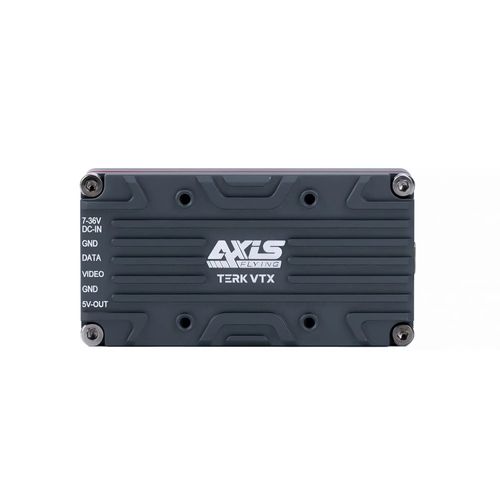
| Wiring Connections | DC-IN, GND, DATA, VIDEO, GND, and 5V-OUT |
| Status Indication | LED indicators for power, frequency band, channel, and PIT mode |
| Audio | Built-in microphone |
Control and Installation Notes
Short-press the Power button to cycle through the available output-power settings.
Press and hold the Power button for approximately two seconds to switch to PIT mode.
Short-press the Band/CH button to cycle through channels CH1–CH8.
Press and hold the Band/CH button for approximately two seconds to change the frequency band.
Connect the DATA wire to a compatible flight-controller control pad when using IRC Tramp.
Use an antenna and receiver compatible with the selected operating frequency and MMCX interface.
Keep the fan and ventilation openings clear during installation and high-power operation.
Confirm that the selected frequency and output power comply with local radio regulations.
FAQ
What output-power settings does this TERK VTX provide?
The supplied version provides PIT, 25mW, 400mW, 600mW, 1.6W, and 3.0W operating modes.
How many channels does this VTX support?
This attachment-defined version supports 56 channels across seven bands: A, B, E, F, R, L, and X. The listed frequency range is 4990–5945 MHz.
Does it support IRC Tramp control?
Yes. The specification identifies IRC Tramp control through the DATA connection. Power, band, and channel settings can also be changed using the onboard buttons.
Does this version support SmartAudio?
The supplied specification identifies IRC Tramp but does not identify SmartAudio. SmartAudio should therefore not be assumed for this attachment-defined version.
What input voltage does the transmitter require?
The marked DC input range is 7–36V. The housing also provides a separate 5V output connection.
How is the transmitter cooled?
It uses a CNC aluminum heat sink and a built-in fan. The ventilation openings should remain clear during installation and operation.
What antenna connection does it use?
The VTX uses an MMCX antenna connector. The antenna and any required pigtail must support the selected operating frequency.
B2B Procurement FAQ
Which version should be confirmed before quotation?
Please confirm that the required version is the 56-channel model with PIT, 25mW, 400mW, 600mW, 1.6W, and 3.0W power settings. Channel plans and power options may differ between product revisions.
Are the wiring harness and RF pigtail included?
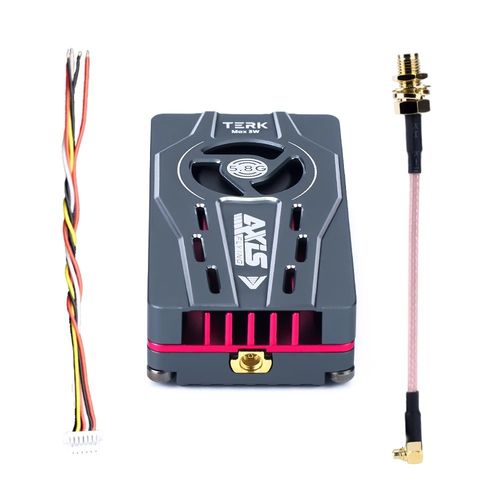
The supplied product images show a wiring harness and an MMCX-to-SMA pigtail. Final package contents must be confirmed in the quotation because accessory configurations may vary.
What information is required for a procurement quotation?
Please provide the required quantity, frequency-plan version, output-power configuration, antenna or pigtail requirements, destination market, and packaging requirements.
What are the MOQ and lead time?
MOQ, production availability, and lead time must be confirmed during quotation.
Can compliance documents be supplied?
Required test reports or compliance documents must be confirmed for the exact product revision and destination market during quotation.
Leave Your Message
Products categories
-
GEPRC ELRS 915M/2.4G C3 Gemini Xrossband
-
SKYDROID 5.8G 150CH UVC OTG FPV Receiver
-
FS2A Mini 4CH AFHDS 2A PWM Receiver
-
TBS Crossfire Nano RX
-
1.2GHz 1500mW Wireless AV Transmitter an
-
Foxeer ELRS 915/868MHz Receiver
-
GEPRC ELRS Nano 915M PA500 Receiver
-
Flysky FGr4 / FGr4S / FGr4P AFHDS 3 Rece
-
CYCLONE ELRS 2400RX-7CH V1.1 Receiver
-
DAKEFPV Ultra1600 / Ultra2500 64CH Analo