

BETAFPV SuperD ELRS 2.4GHz/915MHz Diversity Receiver
Technical Highlights
True Diversity Receiver Architecture
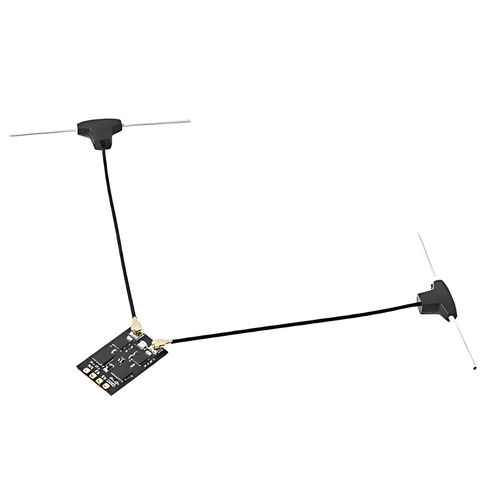
The SuperD uses two complete RF receiver chains and two external antennas. This true diversity design improves signal reception reliability compared with a single-chain receiver, particularly when antenna orientation or surrounding obstacles affect one signal path.
2.4GHz and 915MHz Versions
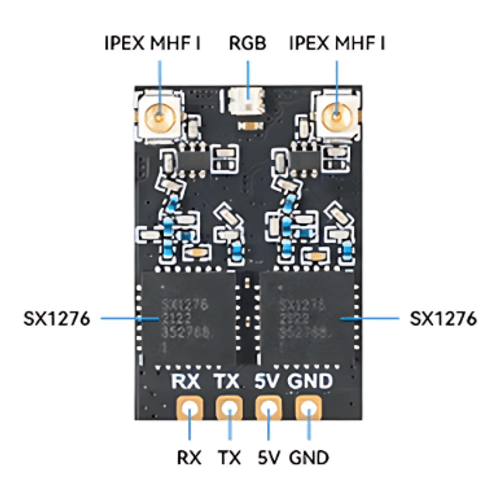
The receiver is available as a 2.4GHz ISM version or a 915MHz version. The 2.4GHz model uses dual SX1280/SX1281 RF chips, while the 915MHz model uses dual SX1276 RF chips. The receiver frequency must match the ExpressLRS transmitter system.
TCXO Frequency Stability
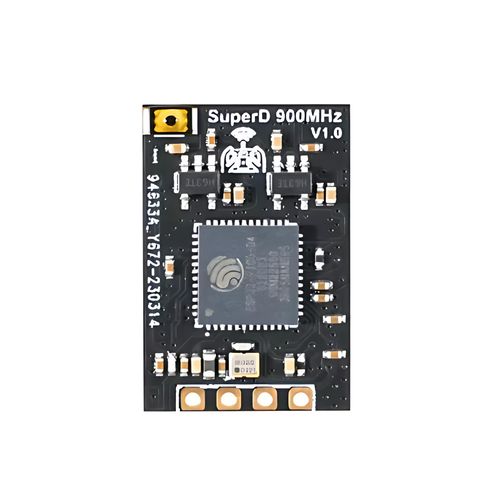
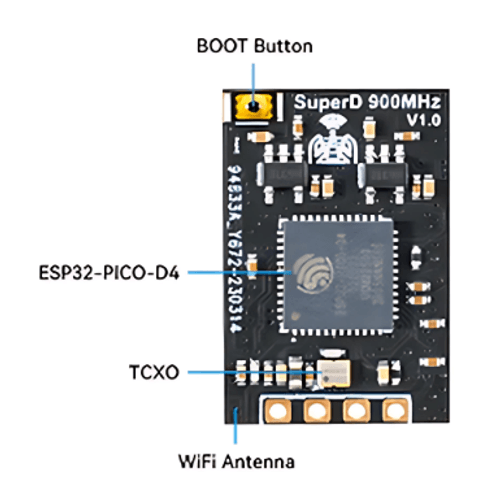
A temperature-compensated crystal oscillator provides a stable clock reference for the RF system. This helps maintain accurate operating frequency as receiver temperature changes during operation.
ExpressLRS with CRSF Output
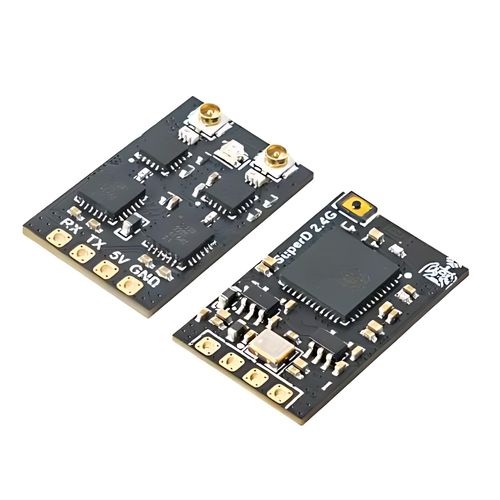
The receiver communicates with a compatible flight controller through the CRSF serial protocol. Dedicated RX, TX, 5V, and GND solder pads provide a straightforward UART connection.
Compact Lightweight PCB
The receiver PCB measures 22 × 14 mm. Weight excluding antennas is approximately 1.1g for the 2.4GHz version and 1.2g for the 915MHz version, making it suitable for weight-conscious FPV installations.
Variant Specifications
| Version | ELRS 2.4GHz | ELRS 915MHz |
|---|---|---|
| Operating Frequency | 2.4GHz ISM | 915MHz |
| RF Chips | Dual SX1280/SX1281 | Dual SX1276 |
| Telemetry Power | 20dBm / 100mW | 17dBm / 50mW |
| Receiver Weight | 1.1g, excluding antennas | 1.2g, excluding antennas |
Electrical and Interface Specifications
| Receiver Protocol | ExpressLRS |
|---|---|
| Serial Output Protocol | CRSF |
| Input Voltage | 5V DC |
| Connection Pads | RX, TX, 5V, and GND |
| Antenna Connectors | Two IPEX MHF1/U.FL connectors |
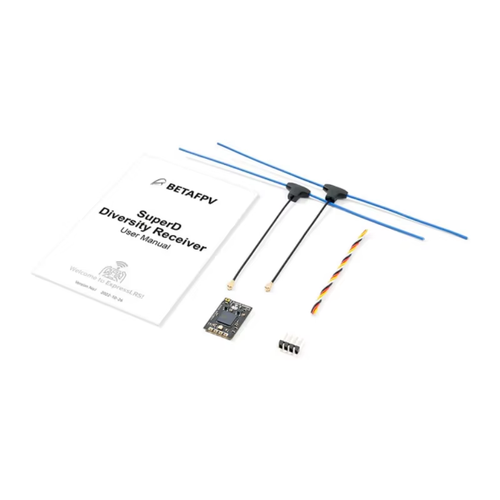
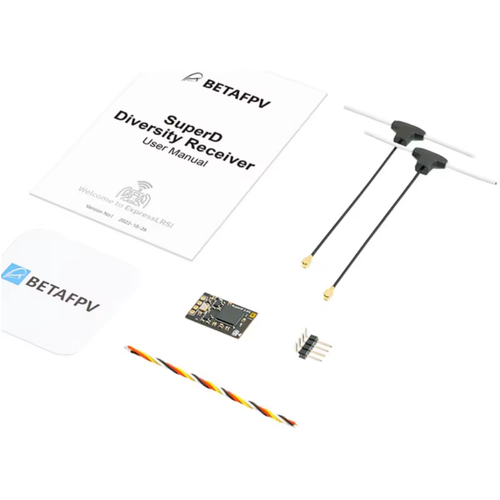
| Antenna Configuration | Two external dipole T antennas |
| PCB Dimensions | 22 × 14 mm |
Installation Notes
Select the receiver version that matches the transmitter module frequency.
Connect the receiver TX pad to the flight controller RX pad and the receiver RX pad to the flight controller TX pad.
Supply regulated 5V power to the receiver through the 5V and GND pads.
Configure the selected flight-controller UART as Serial RX and select CRSF as the serial receiver protocol.
Position the two dipole antennas separately and in different orientations to benefit from the true diversity architecture.
Recommended Applications
FPV freestyle and long-range multirotors
FPV fixed-wing aircraft
Aircraft installations requiring dual-antenna reception
ExpressLRS systems using a CRSF-compatible flight controller
Version Selection Guidance
Choose the 2.4GHz receiver for a matching 2.4GHz ExpressLRS transmitter system. Choose the 915MHz receiver for a matching 915MHz ExpressLRS transmitter system and an installation region where that frequency is permitted. The two receiver versions are not interchangeable with transmitter modules operating on a different frequency band.
FAQ
Is this a video transmitter?
No. The BETAFPV SuperD is an ExpressLRS radio-control receiver. It receives control data from a compatible ExpressLRS transmitter and sends the data to the flight controller through CRSF.
Are the 2.4GHz and 915MHz versions the same receiver?
They are frequency variants in the same SuperD product family, but they use different RF chips and must be paired with a transmitter system operating on the matching frequency band.
What makes the SuperD a true diversity receiver?
It uses two RF receiver chains and two external antennas. The receiver can use the better signal path when antenna orientation or surrounding objects reduce reception on one path.
What flight-controller interface does the receiver use?
It uses the CRSF serial protocol through RX and TX UART connections. The flight-controller UART should be configured for Serial RX with CRSF selected as the receiver provider.
What voltage should be supplied to the receiver?
The receiver requires a regulated 5V DC supply connected to its 5V and GND pads.
Does receiver weight include the antennas?
No. The specified weights of 1.1g for the 2.4GHz version and 1.2g for the 915MHz version exclude the antennas.
B2B Procurement FAQ
Can 2.4GHz and 915MHz versions be included in one quotation?
Both versions can be identified separately in a quotation. Required quantities for each frequency version should be stated clearly to avoid a frequency mismatch.
What information is required before placing an order?
Please confirm the required frequency version, quantity, intended application, destination market, and any packaging or documentation requirements during quotation.
Are MOQ and lead time fixed?
MOQ, stock status, production lead time, and delivery terms must be confirmed during quotation.
Can firmware requirements be specified for an order?
The required ExpressLRS version and transmitter compatibility should be provided for review. Firmware availability and configuration requirements must be confirmed before the order is finalized.
Leave Your Message
Products categories
-
GEPRC ELRS 915M/2.4G C3 Gemini Xrossband
-
SKYDROID 5.8G 150CH UVC OTG FPV Receiver
-
FS2A Mini 4CH AFHDS 2A PWM Receiver
-
TBS Crossfire Nano RX
-
1.2GHz 1500mW Wireless AV Transmitter an
-
Foxeer ELRS 915/868MHz Receiver
-
GEPRC ELRS Nano 915M PA500 Receiver
-
Flysky FGr4 / FGr4S / FGr4P AFHDS 3 Rece
-
CYCLONE ELRS 2400RX-7CH V1.1 Receiver
-
DAKEFPV Ultra1600 / Ultra2500 64CH Analo