

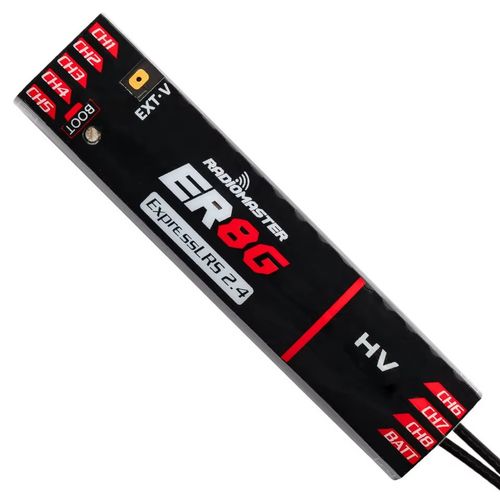
RadioMaster ER8G 2.4GHz ELRS PWM Receiver
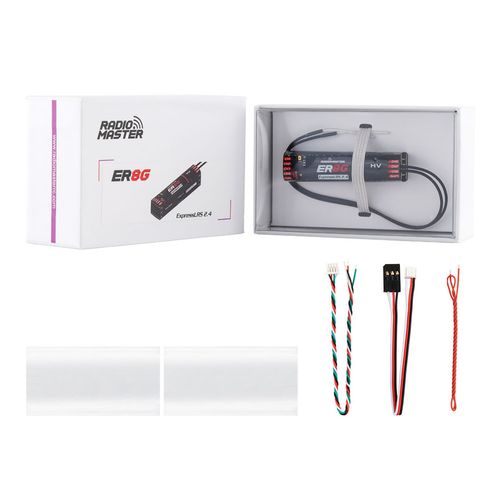
Technical Highlights
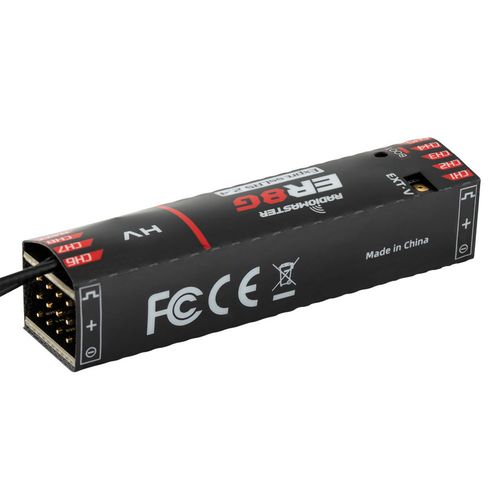
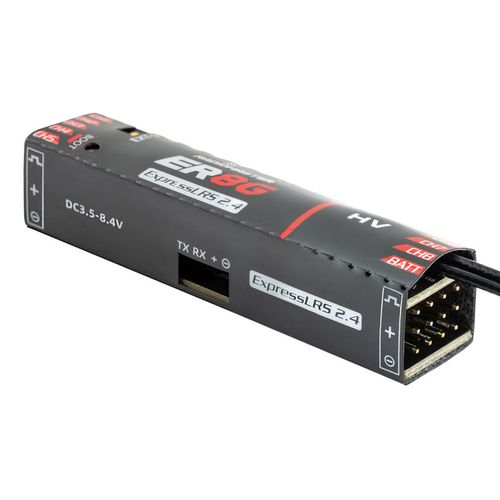
Eight PWM Channels in a Slim Receiver
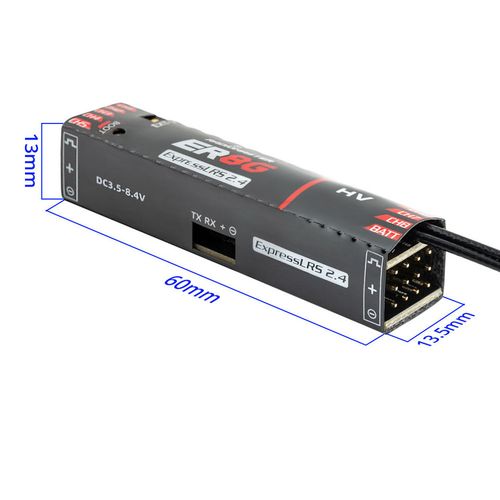
The ER8G provides eight PWM outputs for compatible servos and other PWM-controlled RC equipment. Its 60 × 13.5 × 13 mm housing is suited to installations where a narrow receiver body is useful.
Dual-Antenna 2.4 GHz ExpressLRS Link
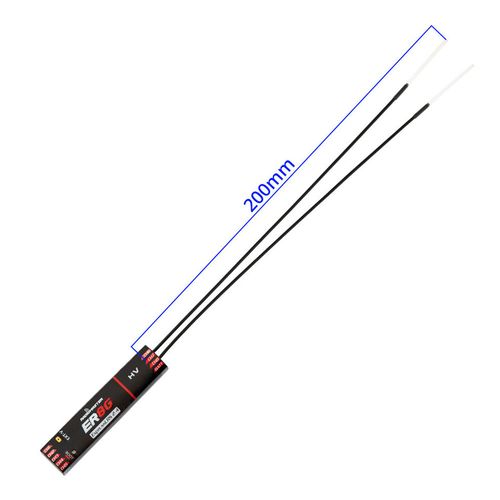
Dual 20 cm high-sensitivity antennas support the 2.4 GHz ExpressLRS radio link. Receiver telemetry power is LUA adjustable up to a maximum of 100 mW; this is not FPV video-transmitter output power.
Receiver and External Battery Voltage Telemetry
The receiver can report its own voltage or an externally measured battery voltage, automatically selecting the voltage input in use. The DC 4.0-35 V external detection range is separate from the DC 3.5-8.4 V receiver supply range.
Configuration and Sensor Expansion
The ER8G supports Wi-Fi updates and WebUI configuration. RadioMaster also specifies CRSF and SBUS serial output options and a reserved four-pin CRSF interface for compatible telemetry-sensor expansion.
ER8G Variant Without Built-In Vario
The ER8G does not include the built-in Vario air-pressure sensor specified for the separate ER8GV variant. Select the correct model when Vario functionality is required or prohibited.
RF and Interface Specifications
| Model | RadioMaster ER8G |
|---|---|
| Product Type | 2.4 GHz ExpressLRS PWM receiver |
| PWM Outputs | 8 channels |
| Wireless Protocol | ExpressLRS; version 3.3.0 pre-installed |
| Telemetry Power | Maximum 100 mW, LUA adjustable |
| Antenna Arrangement | Dual 20 cm high-sensitivity antennas |
| Serial Output | CRSF / SBUS |
| Expansion Interface | Reserved four-pin CRSF interface |
| Built-In Vario | No; Vario is a feature of the separate ER8GV variant |
Electrical and Physical Specifications
| Receiver Power Supply | DC 3.5-8.4 V |
|---|---|
| External Battery Voltage Detection | DC 4.0-35 V; sensing range only, not receiver supply voltage |
| Connector Pitch | 2.54 mm |
| Dimensions | 60 × 13.5 × 13 mm |
| Weight | 12 g |
Integration Notes
Use a compatible 2.4 GHz ExpressLRS transmitter or transmitter module.
Power the receiver within DC 3.5-8.4 V. Do not connect the higher external battery sensing voltage to the receiver supply input.
Check PWM channel assignments, serial-output configuration, servo power requirements, and antenna placement before operation.
If built-in Vario telemetry is required, verify the separately designated ER8GV model rather than assuming it is present in the ER8G.
FAQ
Is the RadioMaster ER8G a video transmitter?
No. It is a 2.4 GHz ExpressLRS radio receiver with eight PWM outputs. The maximum 100 mW specification refers to receiver telemetry power, not FPV video transmission.
Does the ER8G have a built-in Vario sensor?
No. RadioMaster identifies the built-in Vario air-pressure sensor as a feature of the separate ER8GV variant, not the ER8G.
What is the ER8G receiver supply range?
The receiver requires DC 3.5-8.4 V. Its DC 4.0-35 V external battery specification describes voltage detection only and is not the receiver power-supply range.
How many PWM channels and antennas does the ER8G have?
It provides eight PWM channels and uses dual 20 cm high-sensitivity antennas.
Which serial and configuration features are listed?
RadioMaster lists CRSF and SBUS serial output, a reserved four-pin CRSF interface, Wi-Fi updates, and WebUI configuration for the ER8G.
B2B Procurement FAQ
How should the variant be specified in a purchase inquiry?
Specify RadioMaster ER8G 2.4 GHz ExpressLRS eight-channel PWM receiver. State ER8G explicitly to avoid substitution with the separate ER8GV Vario variant.
What details should be checked before placing a bulk order?
Confirm the exact ER8G variant, required quantity, firmware version, supplied accessories, packaging, and commercial terms during quotation.
Are samples, MOQ, lead time, or customization available?
Sample availability, minimum order quantity, lead time, and customization options must be confirmed during quotation.
Can compliance documents be provided?
Required compliance documents and their applicability to the ordered version and destination market must be confirmed during quotation.
Leave Your Message
Products categories
-
RUSHFPV Tiny Tank 5.8GHz VTX
-
RUSHFPV 3.3G 4W VTX Transmitter Module
-
SkyGuy Nano / Max 2.4GHz ExpressLRS Rece
-
RadioMaster ER8G 2.4GHz ELRS PWM Receive
-
RadioMaster ER6 2.4GHz ELRS PWM Receiver
-
RadioMaster ER4 2.4GHz ExpressLRS PWM Re
-
RadioMaster DBR4 Gemini Xrossband Expres
-
RadioMaster Bandit BR3 ExpressLRS Receiv
-
RadioMaster Bandit BR1 ExpressLRS Receiv
-
MATEKSYS R24-P6V ExpressLRS PWM Vario Re