

SkyGuy Nano / Max 2.4GHz ExpressLRS Receivers
Technical Highlights
Two Distinct 2.4 GHz Receiver Options
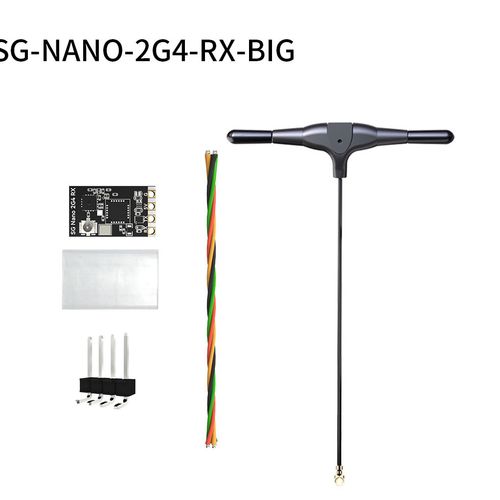
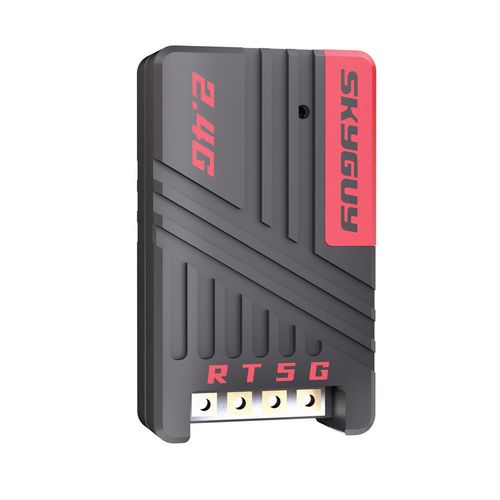
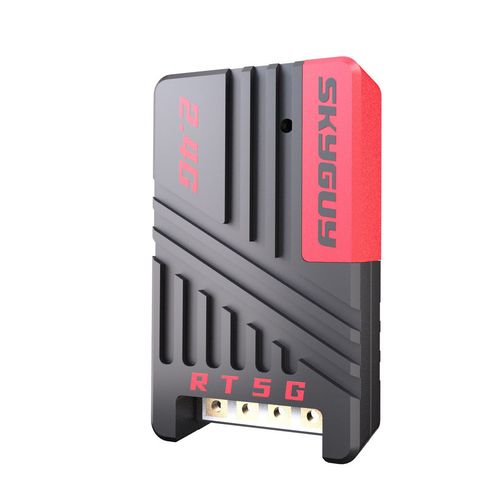
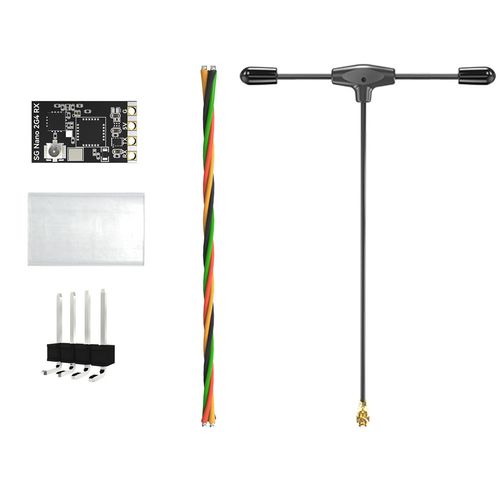
Choose the SkyGuy Nano for a compact 10 × 18 mm receiver board with 100 mW telemetry power, or the SkyGuy Max for a larger 16 × 27 × 7.5 mm housed receiver with selectable telemetry power up to 1000 mW. These are radio-control receivers, not FPV video transmitters.
Model-Specific Telemetry Power
The Nano is specified at 100 mW. The Max provides selectable 25, 50, 100, 250, 500, and 1000 mW power levels. Select a setting permitted by the applicable local radio regulations.
Shared ExpressLRS Hardware Platform
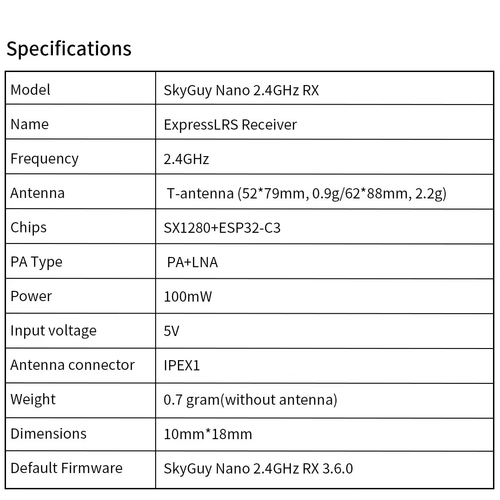
Both models operate at 2.4 GHz, use an SX1280 RF chip with an ESP32-C3 processor, require 5 V input, and provide an IPEX1 connector for a T-antenna.
Lightweight and Big Antenna Choices
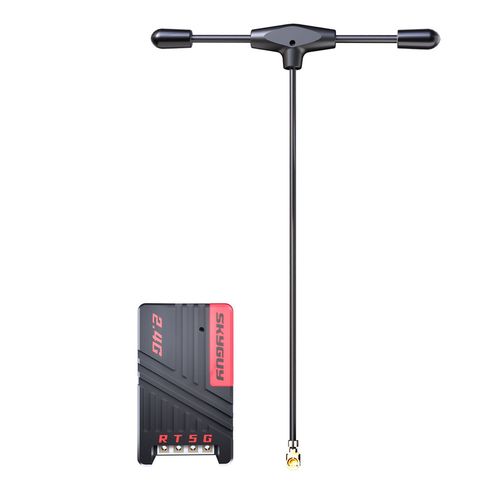
The supplied specifications list two T-antenna options: 52 × 79 mm at 0.9 g and 62 × 88 mm at 2.2 g. Confirm the selected antenna option when ordering either receiver model.
Model Selection
| Specification | SkyGuy Nano | SkyGuy Max |
|---|---|---|
| Model Reference | SG-NANO-2G4-RX | SG-MAX-2G4-RX |
| Operating Frequency | 2.4 GHz | 2.4 GHz |
| Telemetry Power | 100 mW | 25 / 50 / 100 / 250 / 500 / 1000 mW selectable |
| Input Voltage | 5 V | 5 V |
| Chipset | SX1280 + ESP32-C3 | SX1280 + ESP32-C3 |
| Antenna Connector | IPEX1 | IPEX1 |
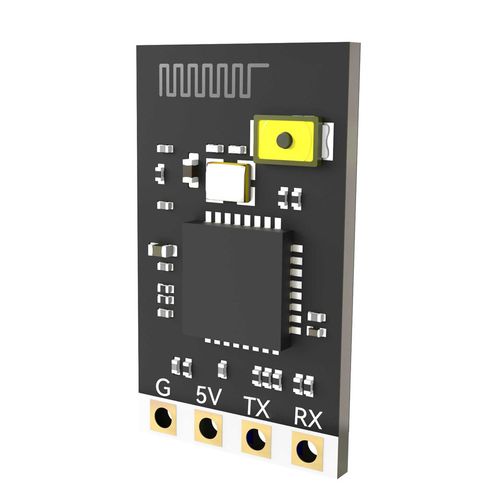
| Dimensions | 10 × 18 mm | 16 × 27 × 7.5 mm |
| Specified Weight | 0.7 g without antenna | 6 g; supplied specification also lists 7.3 g including antenna and CNC enclosure |
| Listed Default Firmware | SkyGuy Nano 2.4GHz RX 3.6.0 | SkyGuy Max 2.4GHz RX 3.6.2 |
Antenna and Interface Details
| T-Antenna Options | 52 × 79 mm, 0.9 g; or 62 × 88 mm, 2.2 g |
|---|---|
| Nano Board Pad Labels | G, 5V, TX, RX |
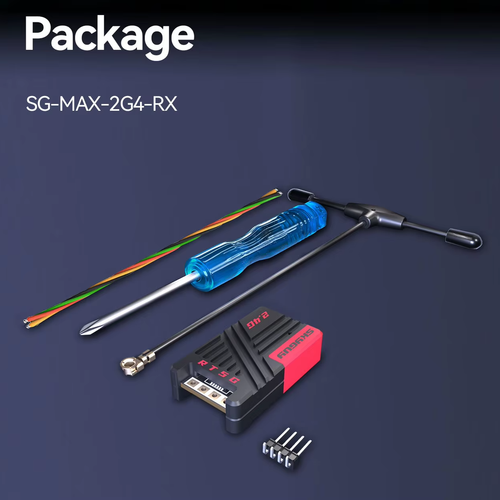
| Max Housing Pad Labels | R, T, S, G |
| Receiver Link | 2.4 GHz ExpressLRS |
Selection and Installation Notes
Select Nano or Max before ordering; their telemetry power, dimensions, weight, and listed firmware versions differ.
Specify the lightweight or Big T-antenna option separately from the receiver model.
Use a regulated 5 V supply and check the selected model's pad labels before wiring.
Do not treat the Max receiver's 1000 mW telemetry setting as video-transmitter power or as a guaranteed flight range.
FAQ
Are SkyGuy Nano and SkyGuy Max the same receiver?
No. They are separate 2.4 GHz ExpressLRS receiver models. The Nano is a 10 × 18 mm board specified at 100 mW, while the larger Max offers selectable telemetry power up to 1000 mW.
Does the Nano support the Max receiver's 1000 mW setting?
No. The supplied Nano specification lists 100 mW. The 1000 mW option belongs to the separate SkyGuy Max model.
Are these products FPV video transmitters?
No. Both are ExpressLRS radio-control receivers. Their mW ratings describe receiver telemetry transmission, not FPV video output.
What power supply and antenna connector do the receivers use?
Both models are specified for 5 V input and use an IPEX1 antenna connector. Check the selected model's pad labels before wiring.
Does the 1000 mW setting guarantee a particular flight range?
No. The supplied material does not establish a guaranteed operating range. Actual link performance depends on the complete radio system, antenna installation, environment, interference, and permitted power setting.
B2B Procurement FAQ
Which model information should be included in an inquiry?
Specify SG-NANO-2G4-RX or SG-MAX-2G4-RX and select the lightweight or Big T-antenna option. Confirm the exact variant on the quotation.
Can Nano and Max specifications be treated as interchangeable?
No. Confirm the selected model's telemetry power, dimensions, weight, firmware version, and interface-pad layout before purchasing.
Are samples, MOQ, lead time, or customization available?
Sample availability, minimum order quantity, lead time, and customization options must be confirmed during quotation.
Can compliance documents or a particular firmware version be supplied?
Required compliance documents, destination-market applicability, and the firmware version of the quoted stock must be confirmed during quotation.
Leave Your Message
Products categories
-
RUSHFPV Tiny Tank 5.8GHz VTX
-
RUSHFPV 3.3G 4W VTX Transmitter Module
-
SkyGuy Nano / Max 2.4GHz ExpressLRS Rece
-
RadioMaster ER8G 2.4GHz ELRS PWM Receive
-
RadioMaster ER6 2.4GHz ELRS PWM Receiver
-
RadioMaster ER4 2.4GHz ExpressLRS PWM Re
-
RadioMaster DBR4 Gemini Xrossband Expres
-
RadioMaster Bandit BR3 ExpressLRS Receiv
-
RadioMaster Bandit BR1 ExpressLRS Receiv
-
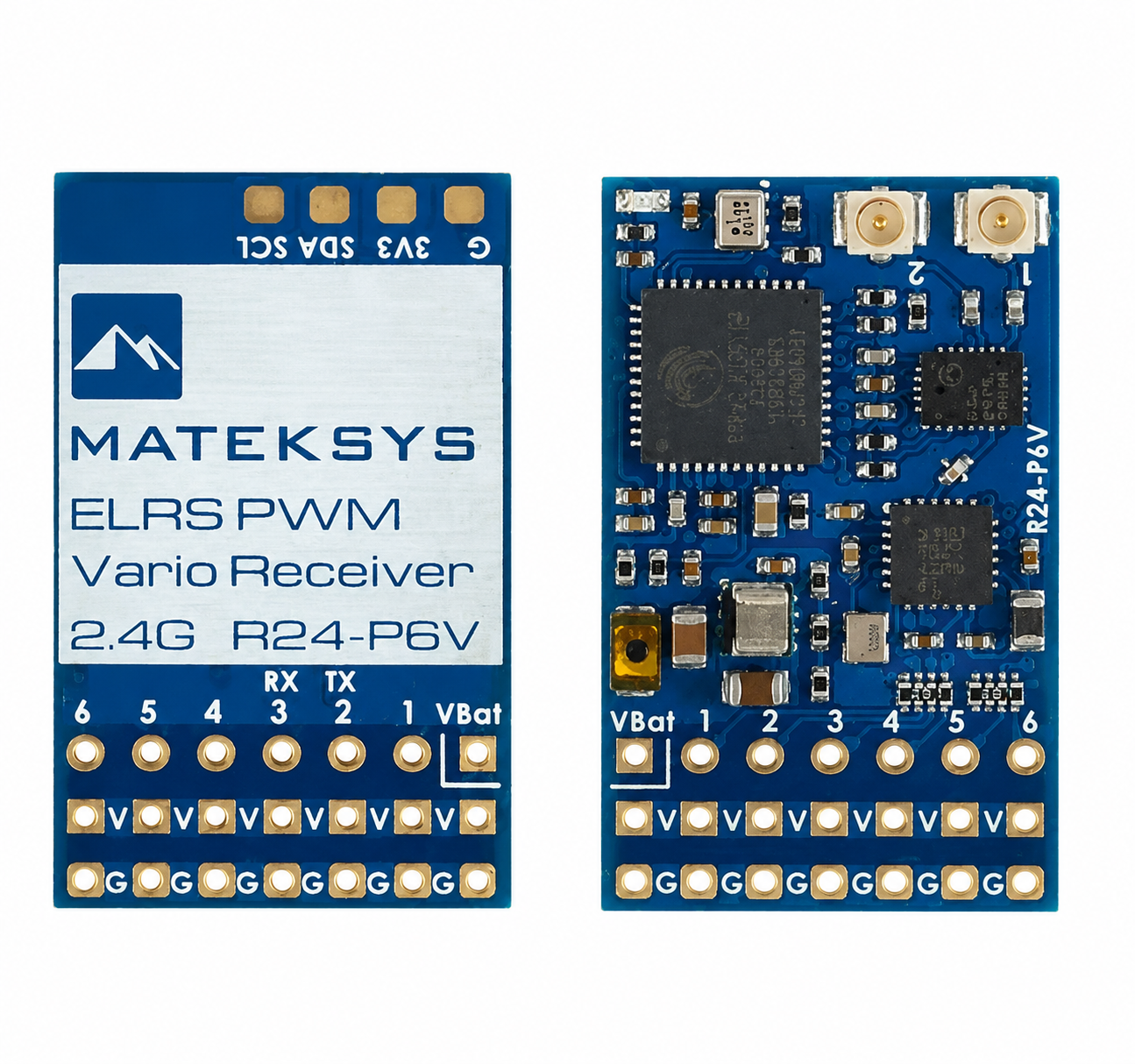
MATEKSYS R24-P6V ExpressLRS PWM Vario Re